We have settled on dates for our upcoming “NAS Fitcheck” run. We’ll be back at LCO for the last 2 weeks of August, and during the last few days we plan to bolt the NAS on the telescope and test as many things as possible.
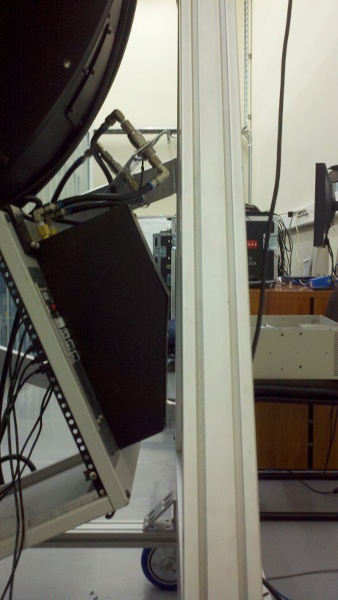
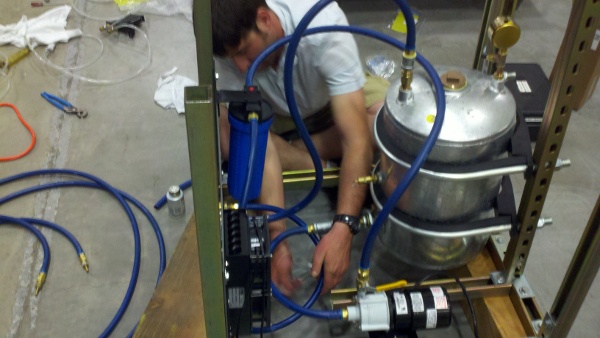
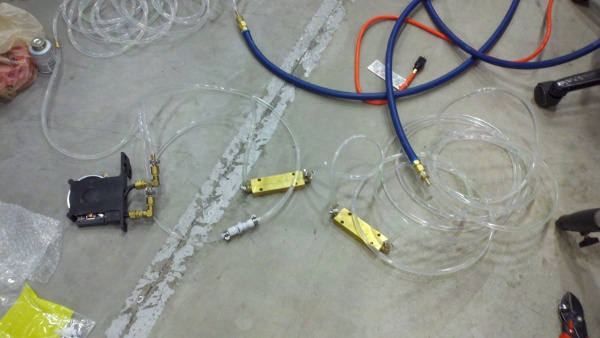
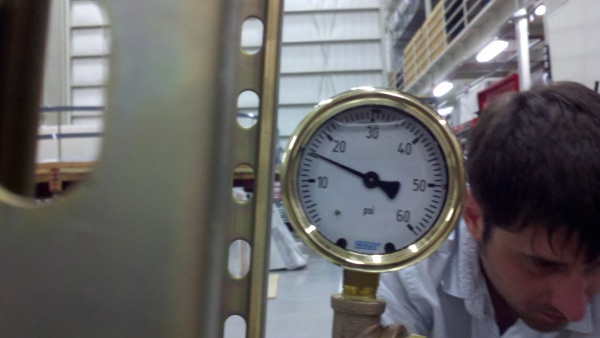
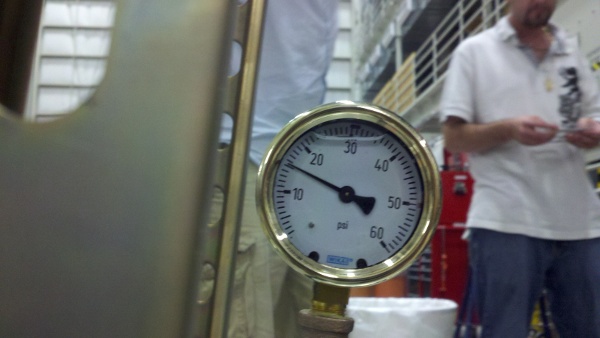
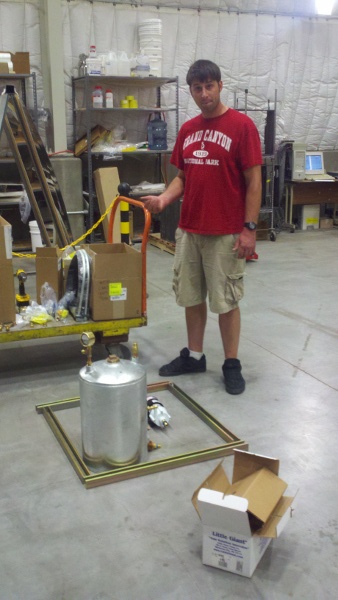
Jason and I are working on assembling and testing a new cooling system for the W-Unit here at the Mirror Lab, and plan to have it ready to be installed with the NAS next month.
Jason Lewis stands next to our new cooling system's tank and pump.
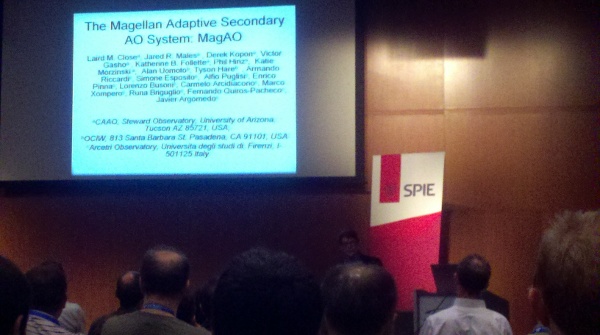
Several members of the MagAO team are in Amsterdam for the SPIE astronomy conference. In addition to presenting several posters and giving some talks, we are also conducting the Clio2 pre-ship review on Wednesday. A busy week.
The Amsterdam RAI conference center is hosting us. The first person to stop by Jared's poster on Monday night and say the word Vizcacha wins a prize.
We said goodbye to Armando and Marco this morning. Thanks for the hard work guys. See you in November.
After they left, Laird and Jared spent the rest of the day covering optics, organizing the cleanroom, backing up disk drives, and generally getting everything presentable. Not quite the way we found it, but presentable. We’re heading down to La Serena on the 1130 transport tomorrow.
I know you’re just here for the animals, so here you go:
On my way to bed last night I suddenly found myself in the middle of the horse herd. This was the best photo I could get by moonlight.The herd was just outside the ASB this morning. As we were walking down for lunch this one took off after his buddies.Once he caught up there was some rough housing.
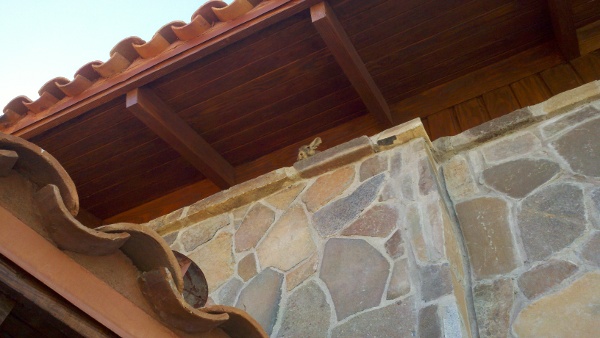
The big accomplishment of the day was finally catching our own glimpse of the famous vizcacha who lives over our clean room.
The cleanroom vizcacha soaking up some sun.He or she kept a close eye on us. Quite a glare actually. Click for full resolution.
In the morning we mounted the calibration return optic (CRO) truss and the CRO itself, to make sure they still fit.
The CRO truss mated to the windscreen.
In the afternoon the ASM was unplugged, and wrapped up for safe keeping while waiting for our turn on the telescope.
Marco and Armando wrap the ASM in plastic to keep it dust free over the next 5 or 6 months.The ASM will stay like this, waiting for us to come back.
Glenn and Jared connected our software to the telescope network today, and tested our communication protocols on a real telescope control system (not connected to a telescope, of course). We found a few error handling bugs on our side, but otherwise it went very smoothly. Our software works!
Glenn Eychaner making the change that allows MagAO to connect to the system.
And finally, after dinner Laird and Jared spent some time playing with the VisAO camera. We have only ever found time to do this a handful of times – we are usually too busy worrying about the WFS or the ASM or some plumbing issue.
We put a new fiber on our alignment laser, which passes the laser’s 630nm light. Previous fibers have corrupted the light too much at this short wavelength. This one worked great, and we were able to take 2.7 pixel images. This is exactly what we expect for our camera imaging a 4.3 micron wide fiber. This corresponds to 20.0 milliarcsecond FWHM on sky at Magellan with our system – amazing!
After that, we started playing with our coronagraph. We have small a metal dot which we can place almost right in front of the CCD47, which we use to block the bright core of starlight.
This screenshot shows our 630 nm source aligned on our occulting spot. (The yellow line is from our image viewer). Note that this is in the lab with no AO.
And returning to our obsession with repeatability, we took a video of slewing our gimbal mirror off the coronagraph and back on. This stability will be extremely important on sky so that we don’t spend time re-aligning on the spot.
We don’t have any animals tonight. I tried to get some bird pictures, but couldn’t get close enough and it would be hard to top the Vizcacha from yesterday. Here’s a shot of LCO from the west.
From the left that's a small telescope used to monitor seeing, the shadow is the 100" inch, the Magellan telescopes are on top, and then we have Telescopio Polaco, and the 40 inch.