MAPS 4th night of 2026B

Coma investigation, telescope nudging, and variable clouds

Instrument: ARIES + MMTAO  ·  Conditions: Variable clouds, intermittent AO


Overview

Night 4 was a challenging one. Variable clouds prevented stable adaptive optics for most of the night, forcing us to work on engineering tasks in the gaps. We used the time productively: we revisited the coma issue first flagged on Night 3, inspected the hardware for a physical cause, and made meaningful progress on coordinated telescope nudging — a capability needed for precise slit acquisition and AGPM coronagraphy with MIRAC.


Coma investigation

Initial hypothesis: ASM–ARIES misalignment

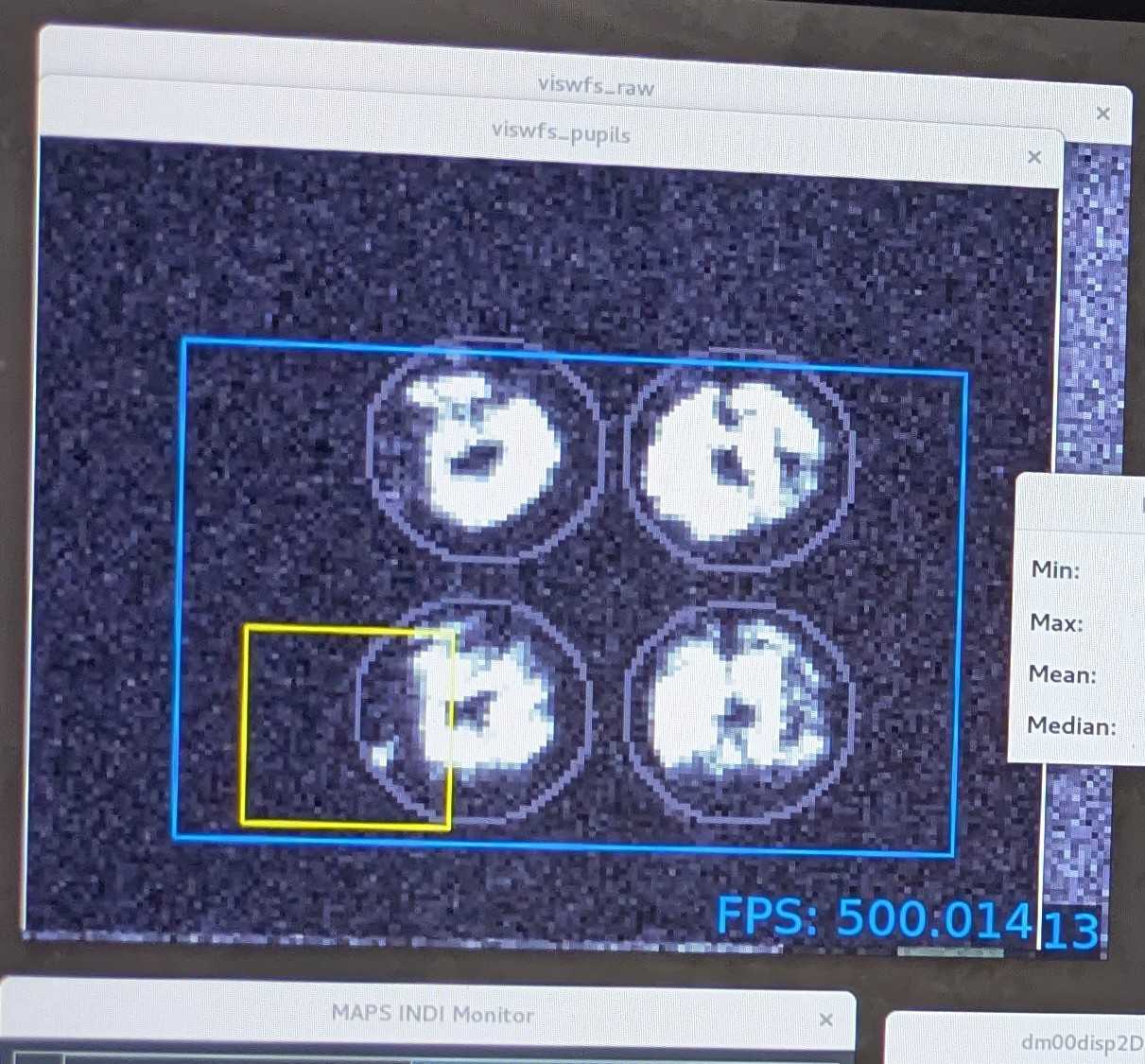
Coming into the night, our working theory was that the coma seen in the wavefront sensor signal originated from a misalignment of the wavefront sensor. If one system was significantly more misaligned than the other, that would point to a clear culprit and a straightforward fix.

Result: both systems contributing equally

When we measured the coma contribution from each system independently, both the ASM and ARIES showed a similar magnitude of error. Neither was the obvious offender — the coma was distributed across both systems.

Hardware inspection

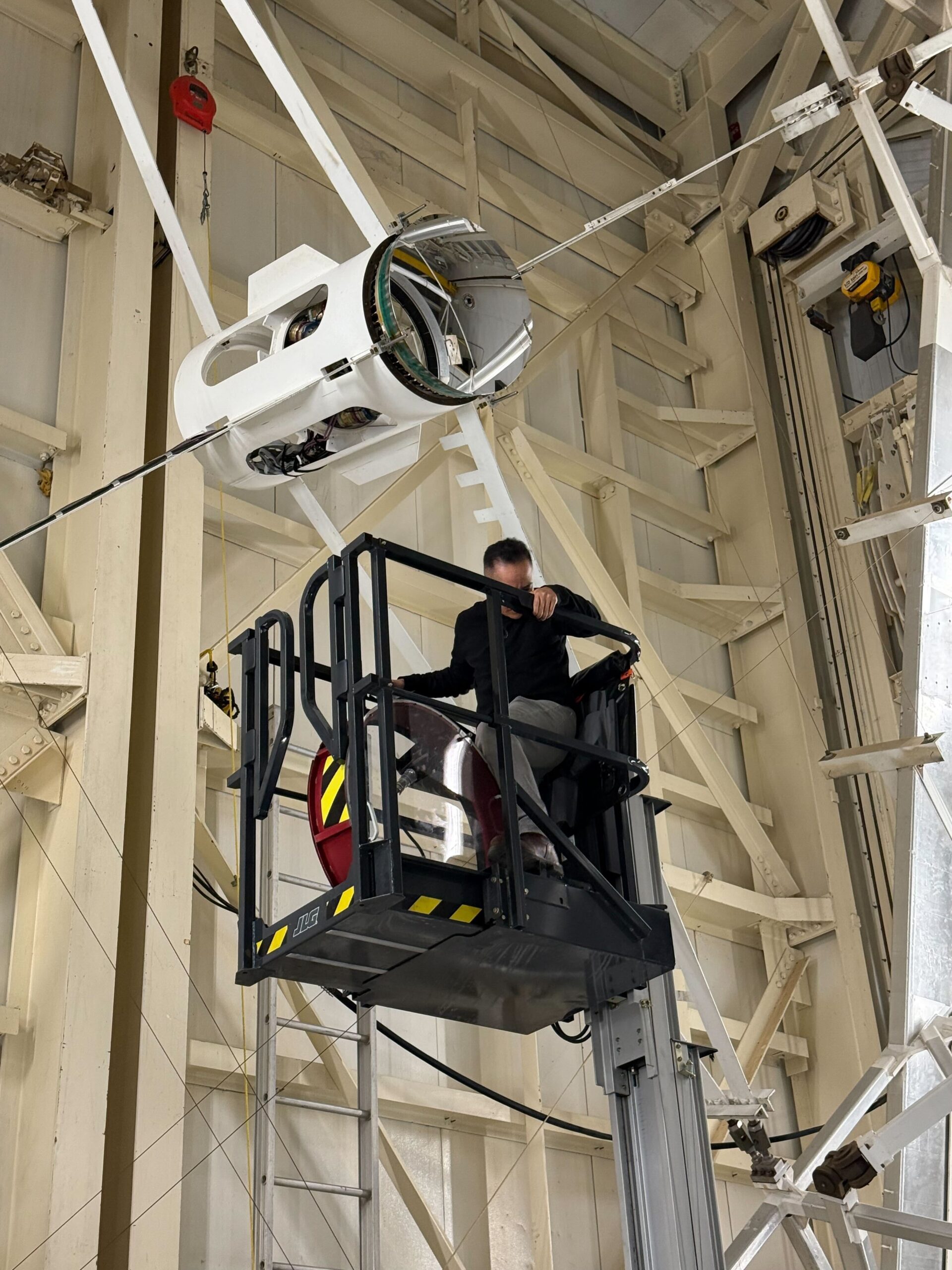
We physically inspected the ASM and the top box to look for anything obviously wrong — a shifted element, a loose mount, anything that could account for a coma error of this magnitude. Nothing was found. There was no visible mechanical cause that explained the level of aberration we are seeing.


Coordinated telescope nudging with AO closed

The problem

When the AO loop is closed, you cannot simply nudge the telescope to move a star — the AO system sees the resulting tip/tilt as a wavefront error and immediately corrects it, moving the mirror to put the star back where it was on the WFS. The star stays pinned to the WFS reference, not to the slit or coronagraph mask. This is fine for AO correction but a problem when you need to precisely position a target on a spectrograph slit or on the AGPM coronagraph with MIRAC.

The solution: coordinated WFS motor and telescope moves

We worked out the combination of moves needed to shift the star on sky while keeping the AO loop closed and the WFS in a valid sensing state. The sequence works as follows:

  1. A coordinated nudge is applied to the WFS motors, shifting the WFS reference position.
  2. The AO system now sees an apparent tip/tilt error — the star is no longer centered on the new WFS reference.
  3. The AO system offloads this tip/tilt to the telescope, commanding the telescope to move.
  4. The telescope slews to re-center the star on the WFS, effectively moving the star on sky to the new position.

The result is a controlled, AO-stable nudge: the star moves on sky, the WFS remains happy, and the loop stays closed throughout. This is the correct approach for keeping a target precisely on a spectrograph slit during long integrations and for AGPM coronagraphy with MIRAC, where sub-diffraction-limit centering on the mask is required.

Scaling factors for nodding

We also performed a large move with the AO system off to establish the scaling factor between the commanded move and the resulting on-sky displacement. This gives us the starting point for nodding variables — the numbers needed to define a nod amplitude that corresponds to a known angular offset on sky.


Weather and on-sky time

Clouds were thick enough for several hours that no light was reaching the WFS, and we were closed for that period. When the clouds thinned toward the end of the night, we recovered a few hours of on-sky time. We were able to test the nudging scheme on a real star — with the AO system both on and off — and confirm that the coordinated move sequence behaved as expected.


Summary and follow-up

Despite the weather, Night 4 produced two concrete results: a clearer picture of the coma problem and a working recipe for closed-loop telescope nudging. The nudging capability is now understood well enough to be used operationally for slit work and AGPM acquisition.

Follow-up items

  • Schedule daytime realignment of ASM and ARIES together to address the distributed coma
  • Document the scaling factor obtained from the large open-loop move for use as nodding starting values
  • Formalize the WFS motor + telescope nudge sequence into a repeatable procedure for slit acquisition and AGPM work
  • Monitor whether the coma level changes after the realignment to confirm the fix
MAPS 3rd night of 2026B

Instrument: ARIES + MMTAO  ·  Sensor: IR wavefront sensor


Overview

The third night of this AO engineering run focused on closing the loop at higher mode counts than previous nights, refining the alignment, and acquiring on-sky data for an ASU science target and a photometric reference for Suresh’s gain comparison.

At the start of the night there were lingering alignment issues from Night 2, so we budgeted time to revisit the bootstrap sequence before pushing to high mode counts.


Planned sequence

  1. Improve pupil alignment
  2. Confirm alignment on the IR wavefront sensor
  3. Check and select flat files
  4. Close loop — bootstrap from 3 modes up to maximum achievable
  5. Observe ASU science target

Night log

Coma and alignment

Significant coma was present at the start of the night. The coma adjustment pushed the hexapod near its travel limit, which caps how much we can correct going forward. A full realignment of both the AO system and ARIES is warranted before the next run — there is something mechanically misaligned upstream.

Flat selection

We tried several flat configurations. None showed a clear advantage over the others, so we settled on the 35 μm gap flat and used it for the remainder of the night. This will be our reference for the run.

WFS alignment

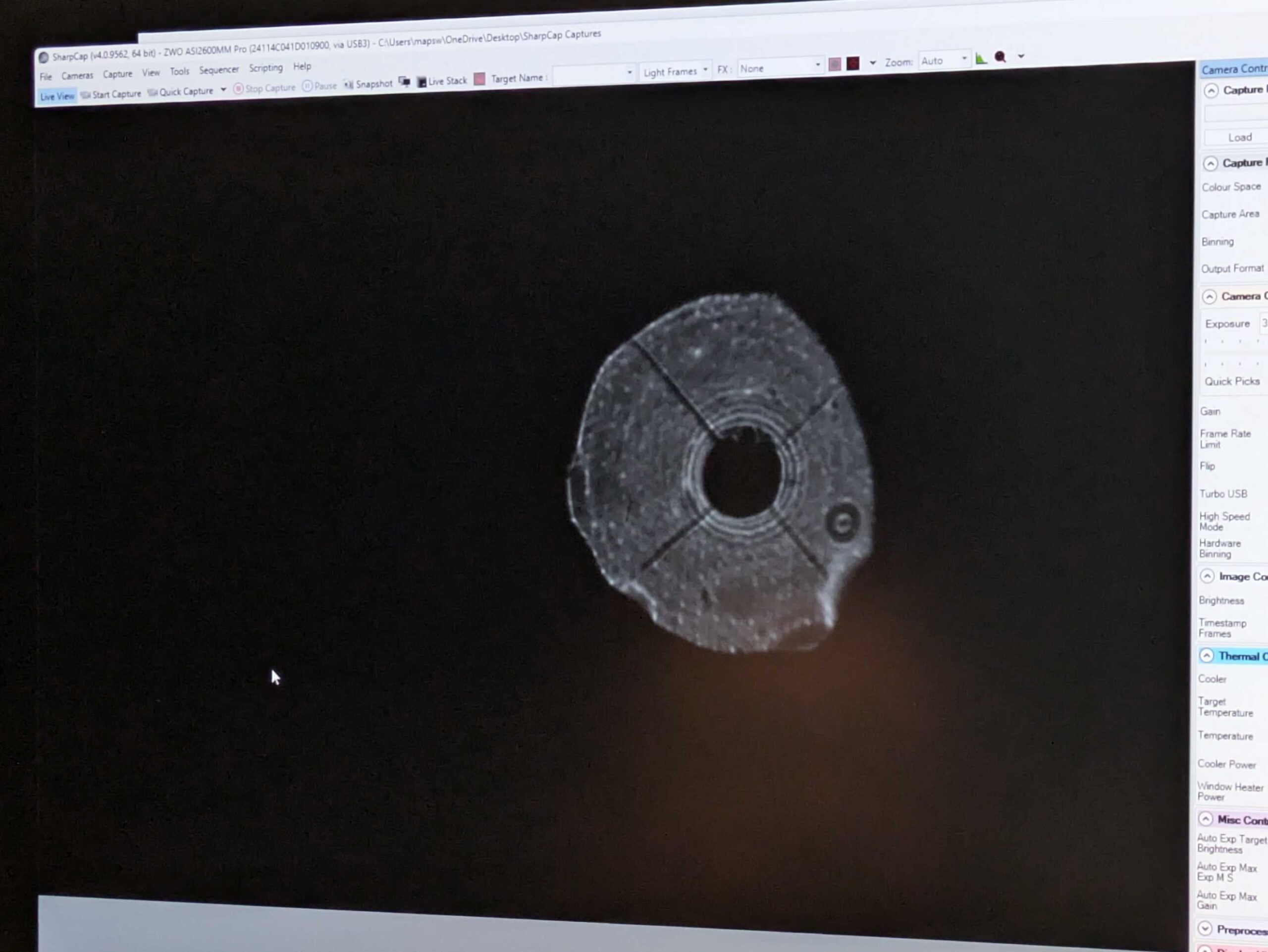
After the alignment iteration, the four pupils on the WFS were better centered and the slope maps looked more symmetric. The improvement was visible by eye.

Bootstrap

Redid the 3-mode and 20-mode loops, going back and forth between mode counts to bring the mirror to a position where the WFS could robustly pick up the surface. The iterative bootstrap was slower than ideal but ultimately got the mirror into the right regime.


Science target — MASCARA-1 b

ParameterValue
V magnitude8.3
K magnitude7.7
IR WFS Detector signal~200 counts (~1% of detector)

Summary and follow-up

The coma and hexapod limit situation is the most pressing issue.

The 32-minute loop run at 50 modes is encouraging — the system is stable when it’s up. The wild coil events are shorter and less frequent than early in the run, suggesting the system is warming up to a more thermally stable state.

MAPS 2nd and First Night of 2026B

First Night we did not open and did check out of hardware and called it an early night.

I wanted to provide a quick update from last night and fill everyone in on what happened.

We were able to get on sky early in the night. After locating the target star, which was initially a little high, we guided it to the center of the dichroic. We then moved on to alignment and were able to proceed to closing the loop and getting the system operational.

A few highlights from the night:

We successfully got Suresh’s gain feature on the IR wavefront sensor working, and it was used throughout the night.
The gain feature helped us work with dimmer guide stars and improved our ability to acquire and correct on fainter targets.
We successfully closed the loop with three modes and were able to bootstrap up to 20 modes. However, the correction was still very unstable, indicating that additional work is needed before we can push to higher-order correction.

Issues encountered:

We appear to have some portions of the shell missing. We are investigating this today to better understand the cause and determine the appropriate corrective actions.
The flat does not appear to be where we would expect it to be, and we will be looking into that as well.
We also believe the optical alignment of the wavefront sensor is not as good as it could be. We plan to spend time today improving the alignment and evaluating its impact on performance.

Overall, the night was productive. We achieved on-sky acquisition, completed alignment, closed the loop, validated the IR wavefront sensor gain feature, and demonstrated bootstrapping from 3 to 20 modes. Today’s focus will be on understanding the shell issue, investigating the flat, improving the wavefront sensor optical alignment, and stabilizing the higher-order correction

MAPS Apr. 2025 Night 1: Six Degrees of Freedom

It is the start of the second run of the semester. The night was focused(pun intended) on alignment and understanding how each one of the movements of the telescope, science camera, and Wave Front Sensor. And what it comes down that each one affects the other and it takes a lot of abstract scratching of head to figure out what happens when a move is done.

The Bad news this run is that the IR Wave front sensor did not make it to the mountain. But we now understand what the problem was. We have been extremely lucky that it worked at all. This is a problem that has been inherently sneaking up on us and we had never been able to figure it out. Turns out that the PCB feed through of the cryostat as it shirinks when it goes to cryo makes contact through hole mounting screws. Good news is that we have a path forward and the fix will soon be implemented.

So the hope for tomorrow night is that the wind stays slow and we get clear skies.

https://www.youtube.com/watch?v=Jn1qkf8vVQU

Sorry No news

System is ready, but Weather is here.

Last night we started the night with clouds above and over 30 mph winds. We got the system ready for on sky time and then waited for the wind to die down. Hopefully it will all clear out and we will start doing some AO’ing soon.