Blog

2015A Day 37: Inside the solar system

This is the final night of my 7-night run at the Clay on MagAO, sharing nights with Alycia & TJ.  I have a few hours per night to image Pluto and Charon with Clio and VisAO, to get their separate photometric light curves in many filters over their 6.4-day period. We’re also doing some astrometry and high-res imaging to prepare for a stellar occultation by Pluto on 29 June. This event will be visible from the area around New Zealand, Australia, and Antarctica, and we have the good fortune of having SOFIA for this event.  The prediction webpage is here.  Even though we’re not observing a Pluto occultation during this run, I’ll give a little background on occultations.

The predicted shadow path of the Pluto occultation on 29 June 2015.  The three solid lines show the paths of Pluto's centerline, upper limb, and lower limb.  The dashed line above Australia is the 3-sigma line from the north limb.
The predicted shadow path of the Pluto occultation on 29 June 2015. The three solid lines show the paths of Pluto’s centerline, upper limb, and lower limb. The dashed line above Australia is the 3-sigma line from the north limb.

When we observe a stellar occultation, we observe the brightness of the star and how quickly it changes as Pluto moves in front of it. From a SNR point of view, it would be optimal if the occulting body were invisible so it wouldn’t add background noise to the observations. For this event, we get pretty close to that as Pluto is 2 mags fainter than the star.

With occultations, we can probe the temperature of Pluto’s atmosphere as a function of altitude but using the known refractivity of component gasses. As Pluto’s atmosphere passes in front of the star, it bends the light thereby dimming it. Using this method, we can detect and measure Pluto’s microbar atmosphere from more than 30 AU away.

Here’s another example of refraction: moonset on Sunday morning. You can see the shape of the moon contract and expand as it passes through different atmospheric layers. With slightly different temperatures (as well as scattering and absorption), the refraction changes from layer to layer.

Some other photos from last night and tonight:

Dave Osip visited us (another MIT alum)
Atom's first night running Clio.  This is Thanawuth (Atom) Thanathibodee, a rising senior at MIT.  He started his summer work two days after finals, and will be working on Pluto all summer.
Atom’s first night running Clio. This is Thanawuth (Atom) Thanathibodee, a rising senior at MIT. He started his summer work two days after finals, and will be working on Pluto all summer.
Our control room tonight (clockwise from left):  Kim Ward-Duong on AO, Atom on Clio, Alberto on all things telescope (and DON'T call him by the wrong name), me falling over in the chair, Katie Morzinski and Jared Males on VisAO.
Our control room tonight (clockwise from left): Kim Ward-Duong on AO, Atom on Clio, Alberto on all things telescope (and DON’T call him by the wrong name), me falling over in the chair, Katie Morzinski and Jared Males on VisAO.
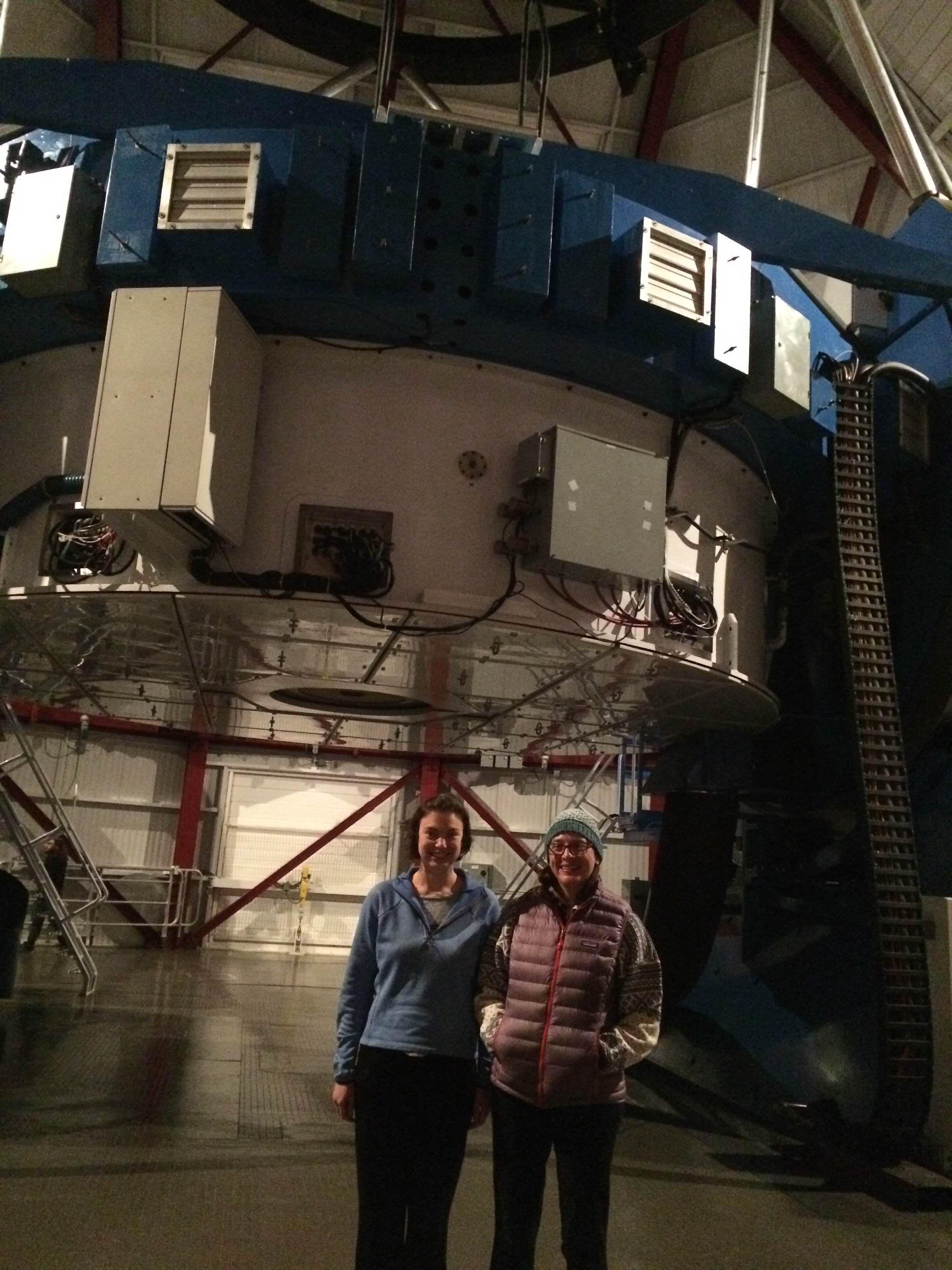
Arizonans.  I think this was the moment after I learned of our common link to Flagstaff.  Kim was an undergrad at NAU and worked at Lowell!  Kim is now in grad school at ASU, and Katie is at U of A.  (I worked at Lowell for 16 years.)
Arizonans. I think this was the moment after I learned of our common link to Flagstaff. Kim was an undergrad at NAU and worked at Lowell, and Katie worked at Lowell too! Kim is now in grad school at ASU, and Katie is at U of A. (I worked at Lowell for 16 years.)

And now the song.  I had to get a primer from Katie, with a run-down of all the various rules.  This is the only song I’m aware of that mentions Pluto specifically.  A quick google search of song lyrics shows that of course there are more, but I’m too tired to listen to them now.  So I’ll give you Christine Lavin’s Planet X:

Sadly, Chris Daughtry does not seem to have covered this (yet).


2015A Day 36: Astronomy or Astrology?

Once I was at an hotel in Santiago and I was trying to check my email from Tololo, where I was working at that time, and suddenly a lady from the cleaning staff saw the Tololo web page and asked me what was that …

“It’s CTIO web page the place where I work”

She looked at me and ask … “Can you do my astrological chart then?”

A bit of humour.

Humor of the day brought to you by Alberto Pasten, who takes his job looking up songs for the MagAO Blog very seriously… also he looks after the telescope 🙂

A classic song …

2015A Day 35: Light Time

My family knows that if they want to plan something for me months in advance of when the next semester’s telescope schedule is released, they should consult a Moon phase calendar and choose a time near New Moon. You, dear readers, undoubtedly know that astronomy and not astrology dictated my schedule — infrared astronomers are usually found on telescopes during “light time,” i.e., when the Moon is up more than half the night. Light time is generally considered less valuable, because you can make observations at any wavelength when the sky is dark, but you can’t do visible light imaging of very faint objects when the sky is bright. That’s why the time before infrared astronomy is known as the dark ages (just kidding).

I was just out walking under the nearly full Moon, which drowned the Milky Way, glinted off the reflective Magellan domes, and cast my shadow upon a lit ground. So, of course, I was contemplating whether the history of science would be different if we had no Moon or two moons. What if we hadn’t had the monthly circuit of the Moon to teach us orbital dynamics and the laws of gravity and the geometry of our Solar System? Or what if we had multiple Moons that kept the sky bright all month and prevented us from observing deep space? Why, then we really would have been in the light-time dark-ages until the advent of infrared astronomy! Perhaps even worse, what if Jupiter hadn’t had bright moons that Galileo could see orbiting? How much longer would it have taken to arrive at a theory of gravity and an accurate picture of our place in the Universe?

I confess I’m being an overly smug infrared astronomer here. Tomorrow the Moon will be near a target I want to observe, and though our infrared camera won’t care, the wavefront sensor works in the visible and we’ll have to see just how flooded with photons it is. That could really make me a lunatic. See how the Moon drowns the all sky camera:

Moon
All sky camera shows Moon and only Moon.

On a separate topic, both Magellans and the duPont telescope are being run by female astronomers tonight! I will here put in a shameless plug for our other blog, Las Campanas Belles. If you don’t speak Spanish and/or don’t know about the ringing rocks, you at least have to check it out to find out why we call it that. Here are some of our observers:

four women observers
Alycia Weinberger, Amanda Bosh, Jackie Faherty, and Katie Morzinski

With all this talk of the Moon and ladies, tonight’s song has to be “I wished on the Moon” by the Billie Holiday, the lady who sings the blues. Tonight, we’re not singing the blues because it’s a great night. Paradoxically perhaps, listening to Billie Holiday makes me happy.

If you really must listen to any other version (Jared), you can listen to this one, but only Billie Holiday will do for my wishes on the Moon. And I refuse to look for a parody of it.

2015A Day 34: Still Alive

34 days and counting. My own record is 23 nights, all alone by myself at SMARTS 0.9. So I can relate to the AO Team: you do start seeing life down the hill as a dream.

And I can say that this run has been a somewhat dark for the team: it can be either wind, clouds, hardware or whatever, but you start to miss uneventful nights. Te ones where you fall sleep of boredom.

But let’s stop bringing you down! You’re way past the half mark, just a couple of weeks and down you go! To (undisclosed high octane beverage), (undisclosed delicious snack) and (undisclosed undisclosed undisclosed).

Now to the tunes:

And (Ohhh my!) I’m going to bend the rules (just bending, both songs actually are part of the same end credits: Portal and Portal 2):

2015A Day 33: Don’t Panic

For the third day in a row, the internet connection is spotty to nonexistent. I was thinking  about the early 90s, when I was a graduate student, and my advisor, Gerry Neugebauer, was the director of Palomar Observatory. He wasn’t keen on getting internet to the dome because, as I recall, he thought astronomers would waste time on their email and pay
insufficient attention to their observing and that they would come to the mountain unprepared. I think both things do happen, but that generally the benefits of connectivity are enormously high. How else could we blog?
Seriously, though, while we could come prepared with any object we might possibly want to observe, instead we can find the coordinates of objects and their finding charts when we want/need them. While we could come prepared with a library of papers on all those targets, instead we can download them when we need them. When technical difficulties arise, it’s essential to contact the experts who aren’t on the mountain. And  being all the way in Chile is made much nicer by being able to call home easily with VOIP.

As if the internet weren’t already crisis enough, we’ve had technical difficulties with the AO stages last night and tonight (see last night’s blog post and my above comment about contacting experts who aren’t on the mountain and who are, in this case, in Italy).

You might we wondering, am I telling you absolutely everything?

Well not exactly. If that weren’t two crises enough, Katie and Jared are almost out of their Starbucks instant coffee. Panic could ensue before they’re resupplied (see 39 seconds in):

You can tell that’s an old movie because of all the leg room the passengers had. American Airlines executives today would be incredulous at how they could fly such empty planes;  it’d be like the incredulity young astronomers show about how we could live without internet at the telescope.

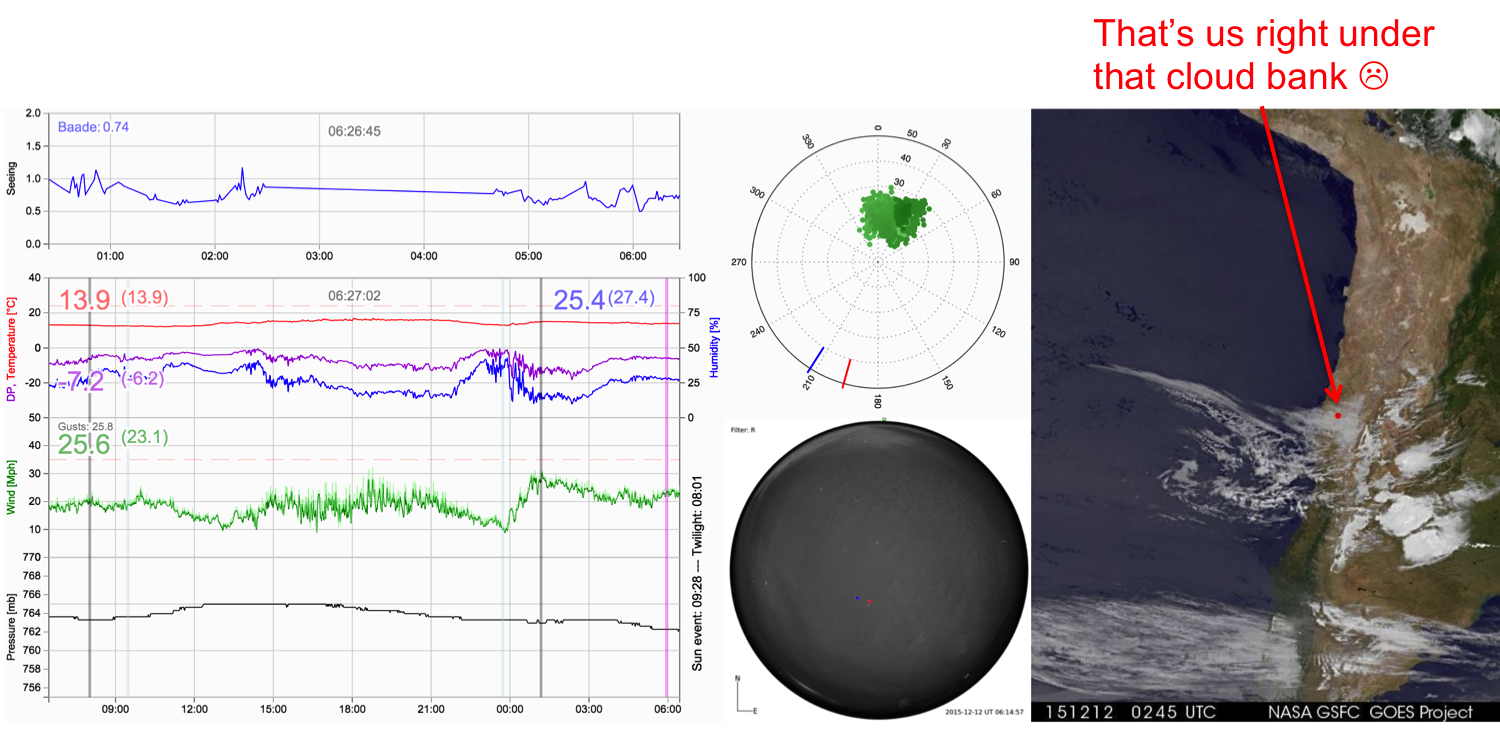
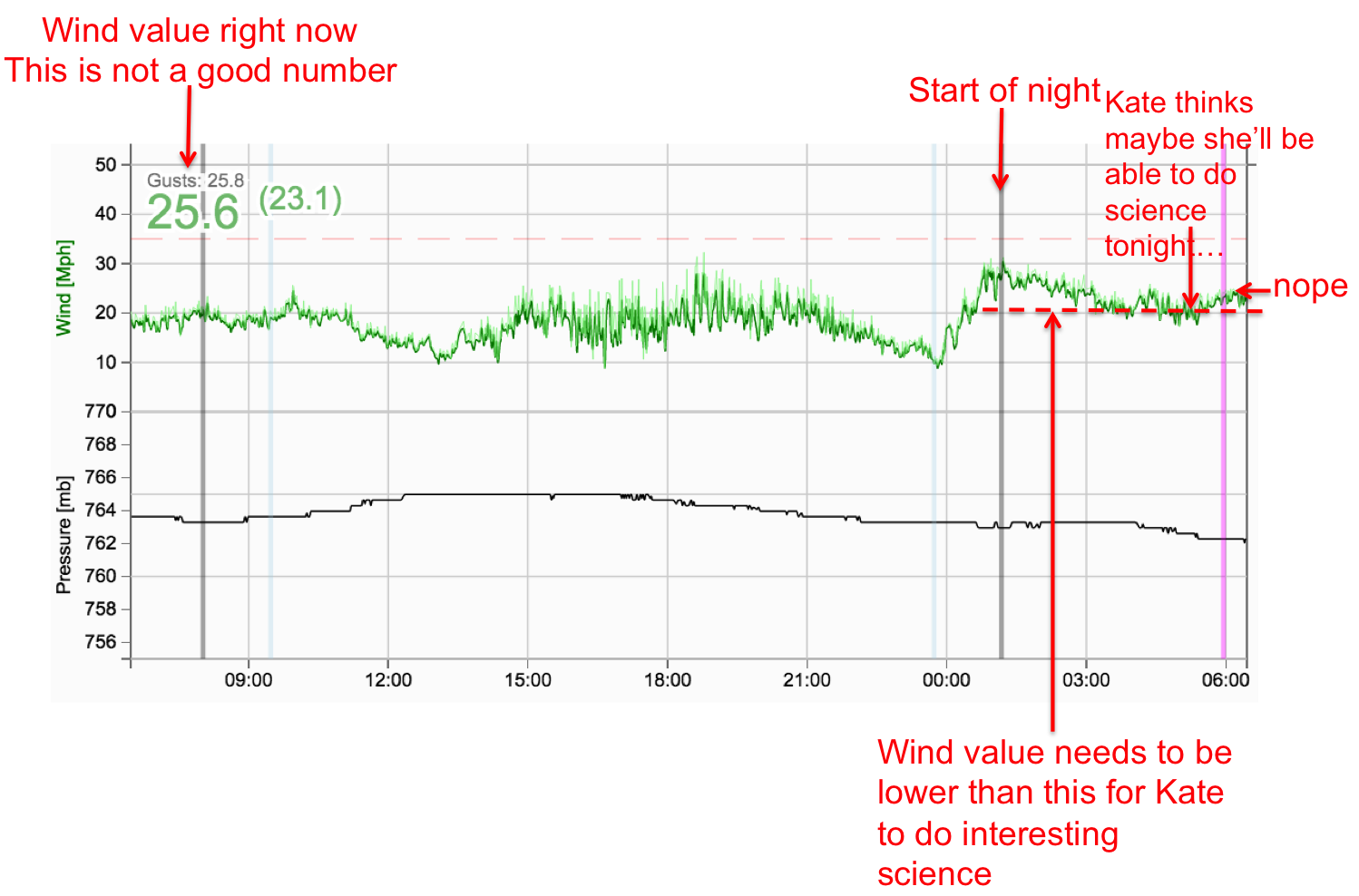
On a happy note, the wind is low, and the clouds have moved off just north of us:

A nice looking weather page.

Since the winds are in our favor, I would post some wind music  from Wind (I don’t think it’s ever been covered), but we don’t have internet access to YouTube tonight. Or email. But we are doing infrared astronomy and weirdly the connections to astronomical databases are working.  Gerry, here’s a toast to your memory.

Edit: I’m back to post the “Wind song” from Wind:

Post Edit by the Blog Administrators to comply with The 2015A Blog Rules: