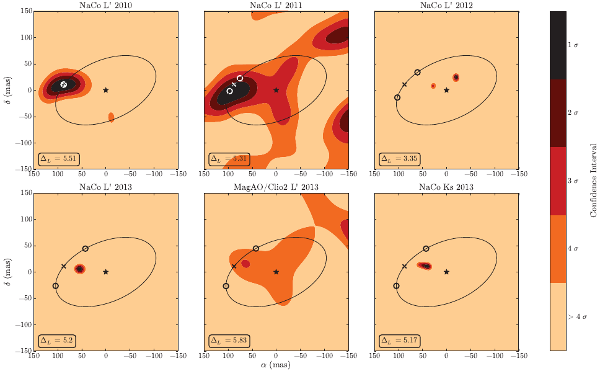
χ2 slices at the fixed contrast ratio for all L observations as well as 2013 NaCo Ks observations, with filled contours at 1 to > 4σ confidence limits. The line indicates a circular orbit in the plane of the outer disk. The ×s show the initial position of the putative companion from our re-reduction of the 2010 NaCo L data, while the circles show the predicted position(s) of a planet on the orbit. We plot two since the planet could be orbiting in either direction.
Abstract: We present multi-epoch non-redundant masking observations of the T Cha transition disk, taken at the VLT and Magellan in H, Ks, and L’ bands. T Cha is one of a small number of transition disks that host companion candidates discovered by high-resolution imaging techniques, with a putative companion at a position angle of 78 degrees, separation of 62 mas, and contrast at L’ of 5.1 mag. We find comparable binary parameters in our re-reduction of the initial detection images, and similar parameters in the 2011 L’, 2013 NaCo L’, and 2013 NaCo Ks data sets. We find a close-in companion signal in the 2012 NaCo L’ dataset that cannot be explained by orbital motion, and a non-detection in the 2013 MagAO/Clio2 L’ data. However, Monte-carlo simulations show that the best fits to the 2012 NaCo and 2013 MagAO/Clio2 followup data may be consistent with noise. There is also a significant probability of false non-detections in both of these data sets. We discuss physical scenarios that could cause the best fits, and argue that previous companion and scattering explanations are inconsistent with the results of the much larger dataset presented here.
Sallum, S., et al. “New Spatially Resolved Observations of the T Cha Transition Disk and Constraints on the Previously Claimed Substellar Companion” ApJ, 801, 85, 2015arxiv preprint
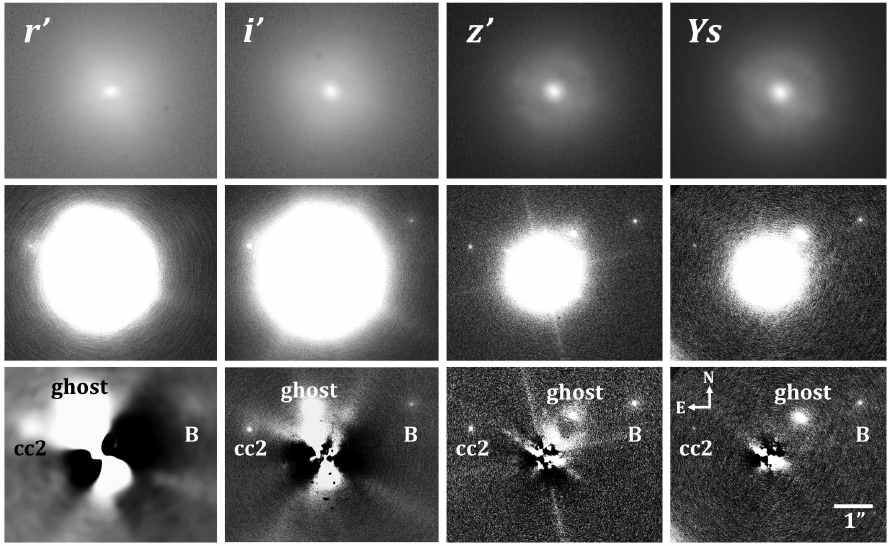
CT Cha in MagAO filters. Image contrasts are adjusted to bring out the objects. Top row: unsaturated dataset showing the PSF. Middle row: reduced, saturated dataset before any halo subtraction. Bottom row: primary’s halo removed by subtracting a rota- tionally symmetric PSF.
Abstract:
We used the Magellan adaptive optics (MagAO) system and its VisAO CCD camera to image the young low mass brown dwarf companion CT Chamaeleontis B for the first time at visible wavelengths. We detect it at r’, i’, z’, and Ys. With our new photometry and Teff~2500 K derived from the shape of its K-band spectrum, we find that CT Cha B has Av = 3.4+/-1.1 mag, and a mass of 14-24 Mj according to the DUSTY evolutionary tracks and its 1-5 Myr age. The overluminosity of our r’ detection indicates that the companion has significant Halpha emission and a mass accretion rate ~6*10^-10 Msun/yr, similar to some substellar companions. Proper motion analysis shows that another point source within 2″ of CT Cha A is not physical. This paper demonstrates how visible wavelength AO photometry (r’, i’, z’, Ys) allows for a better estimate of extinction, luminosity, and mass accretion rate of young substellar companions.
Wu, Y.-L., et al. “New Extinction and Mass Estimates from Optical Photometry of the Very Low Mass Brown Dwarf Companion CT Chamaeleontis B with the Magellan AO System” ApJ, 801, 4, 2015arxiv preprint
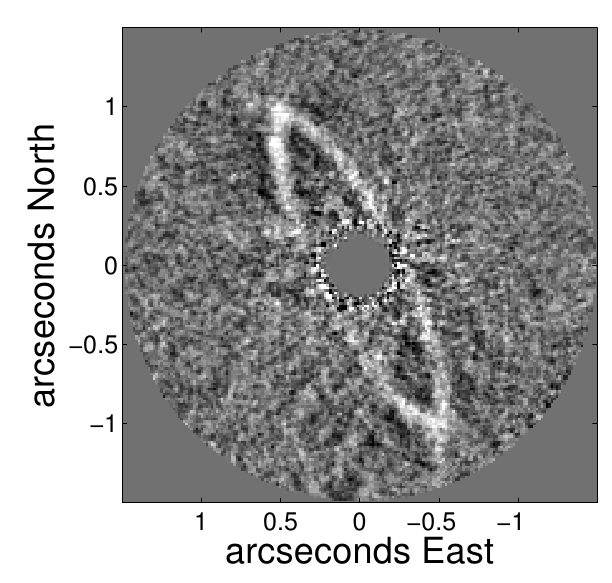
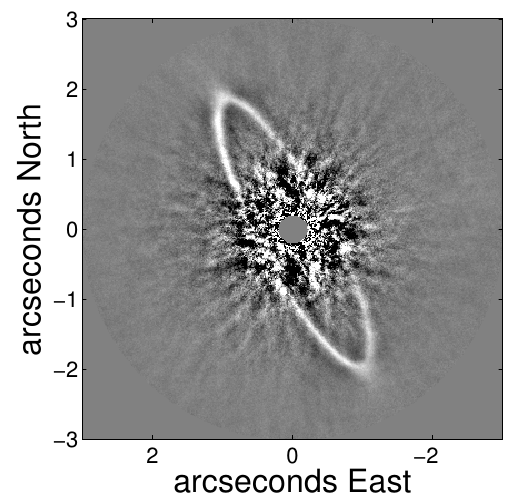
HR 4796 at L’ (3.8 microns)HR 4796 at z’ (0.91 microns)
Abstract:
We present resolved images of the HR 4796A debris disk using the Magellan adaptive optics system paired with Clio-2 and VisAO. We detect the disk at 0.77 microns, 0.91 microns, 0.99 microns, 2.15 microns, 3.1 microns, 3.3 microns, and 3.8 microns. We find that the deprojected center of the ring is offset from the star by 4.76 ± 1.6 AU and that the deprojected eccentricity is 0.06 ± 0.02, in general agreement with previous studies. We find that the average width of the ring is 14+3-2% (11.1+2.4-1.6 AU), also comparable to previous measurements. Combining our new scattered light data with archival Hubble Space Telescope images at ~0.5-2 mum, along with previously unpublished Spitzer/MIPS thermal emission data and all other literature thermal data, we set out to constrain the chemical composition of the dust grains. After testing 19 individual root compositions and more than 8400 unique mixtures of these compositions, we find that good fits to the scattered light alone and thermal emission alone are discrepant, suggesting that caution should be exercised if fitting to only one or the other. When we fit to both data sets simultaneously, we find that silicates and organics are generally the most favored, while large abundances of water ice are usually not favored. These results suggest the HR 4796A dust grains are similar to interstellar dust and solar system comets, though improved modeling is necessary to place better constraints on the exact chemical composition of the dust.
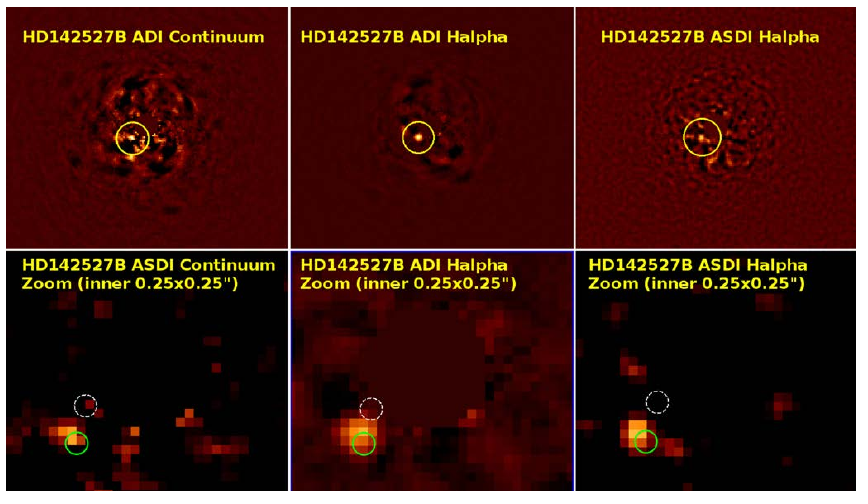
MagAO+VisAO images of the companion HD 142527 B, made with our special “simultaneous differential imaging”, or SDI, mode.
We utilized MagAO to obtain very high-resolution visible light images of HD142527 with MagAO’s VisAO science camera. In the median seeing conditions of the 6.5m Magellan telescope (0.5 − 0.7′′), we find MagAO delivers 24-19% Strehl at Ha (0.656 mm). We detect a faint companion (HD142527B) embedded in this young transitional disk system at just 86.3±1.9 mas (~12 AU) from the star. The companion is detected in both Halpha and a continuum filter (Dmag=6.33±0.20 mag at Ha and 7.50±0.25 mag in the continuum filter). This provides confirmation of the tentative companion discovered by Biller and co-workers (a past graduate of Dr. Close, who is now a professor at the University of Edinburgh) with sparse aperture masking at the 8m VLT.
MagAO found that the Halpha emission from the ~0.25 solar mass companion (EW=180 Angstroms) implies a mass accretion rate of ~5.9×10⁻¹⁰ Msun/yr, and a total accretion luminosity of 1.2% Lsun. Assuming a similar accretion rate, we estimate that a 1 Jupiter mass gas giant could have considerably better (50-1000x) planet/star contrasts at Halpha than at H band (COND models) for a range of optical extinctions (3.4-0 mag). We suggest that 0.5-5 Mjup extrasolar planets in their gas accretion phase should be much more luminous at Halpha than in the NIR. This is the motivation for our new MagAO GAPplanetS survey for extrasolar planets which is a key project for the MagAO team, and in particular senior PhD student Kate Follette who has lead most of the GAPplanets work to date.
Here is the Astrophysical Journal abstract:
“We utilized the new high-order 585 actuator Magellan Adaptive Optics system (MagAO) to obtain very high-resolution visible light images of HD 142527 with MagAO’s VisAO science camera. In the median seeing conditions of the 6.5 m Magellan telescope (0.”5-0.”7), we find MagAO delivers 24%-19% Strehl at Halpha (0.656 mum). We detect a faint companion (HD 142527B) embedded in this young transitional disk system at just 86.3 ± 1.9 mas (~12 AU) from the star. The companion is detected in both Halpha and a continuum filter (Deltamag = 6.33 ± 0.20 mag at Halpha and 7.50 ± 0.25 mag in the continuum filter). This provides confirmation of the tentative companion discovered by Biller and co-workers with sparse aperture masking at the 8 m Very Large Telescope. The Halpha emission from the ~0.25 solar mass companion (EW = 180 Å) implies a mass accretion rate of ~5.9 × 10⁻¹⁰ M sun yr-1 and a total accretion luminosity of 1.2% L sun. Assuming a similar accretion rate, we estimate that a 1 Jupiter mass gas giant could have considerably better (50-1000×) planet/star contrasts at Halpha than at the H band (COND models) for a range of optical extinctions (3.4-0 mag). We suggest that ~0.5-5 M jup extrasolar planets in their gas accretion phase could be much more luminous at Halpha than in the NIR. This is the motivation for our new MagAO GAPplanetS survey for extrasolar planets.”
You can read more about it here:
Close, L. M., et al. “Discovery of Hα Emission from the Close Companion inside the Gap of Transitional Disk HD 142527” ApJ, 781, L30, 2014ADSarxiv preprint
According to the blog, we were working the night shift for 36 nights (see Povilas, the blog can be useful). That means we’re almost completely nocturnal at this point, and not doing so well at this “awake during normal hours” thing. We have an overnight flight from Santiago to Dallas tomorrow night — it may be a long one.
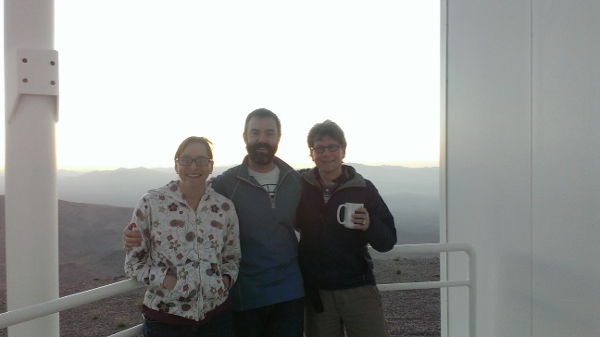
The MagAO team took in one last sunset.
MagAO is all packed up and ready for its ~6 month rest. It’s well deserved — we really made the system work hard this time.
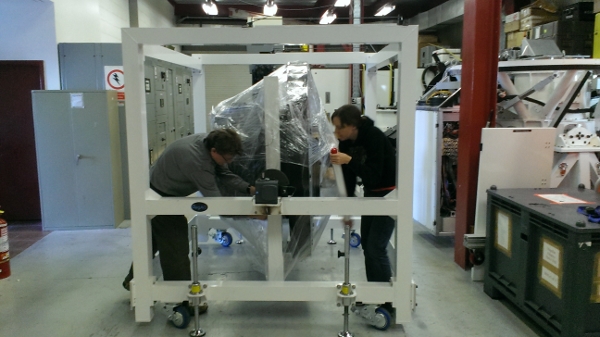
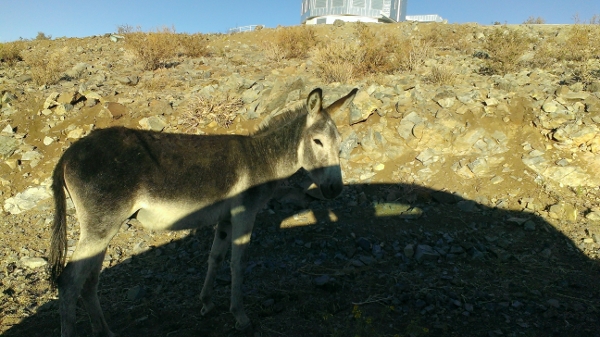
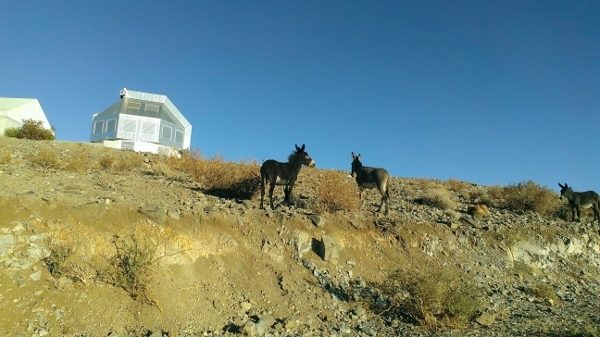
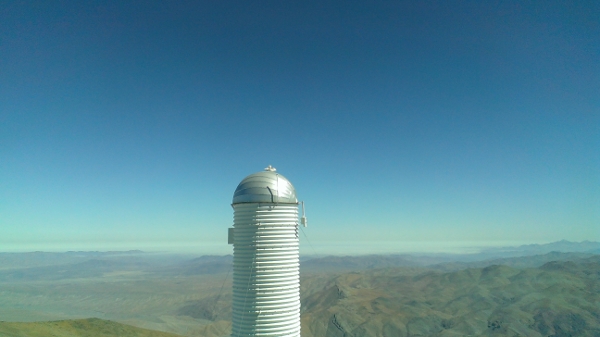
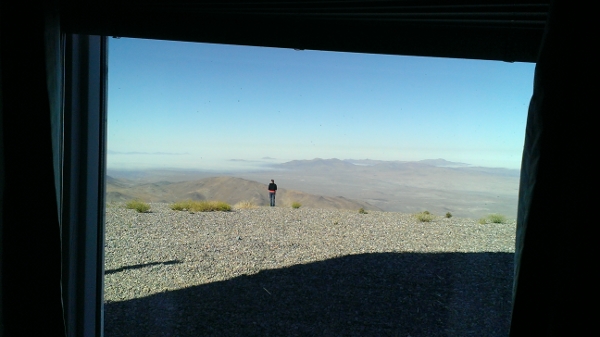
Katie and Laird wrapped up the ASM. This is to keep dust out.The Burro herd came up to see Katie and me off on our last morning. They formed a guard of honor for us along the road.So long guys! See you soon.A trio of Storks (!) caused a bit of a commotion by perching on the DIMM this morning.Katie took some time to say goodbye to the gorgeous view from Cerro Manqui.
As we used to say in the Navy, just a wake-up to go. We leave at 10 am, and then it’s time to celebrate.