Hi MagAO fans, it’s been a while since we’ve updated our blog. After we recovered from our month on the mountain, and got through Christmas, New Years, and the start of the new school year, the team has jumped into processing all the fantastic data we got from MagAO, Clio, and VisAO.
In one month, we’ll be back at LCO doing our thing. It’s a little shorter run this time, but still more than three weeks.
While you wait for us to get back to work, you can get your cutting edge high-res/high-contrast science fix at the LBTI blog. There you can see how MagAO teammates Phil Hinz, Vanessa Bailey and Andy Skemer are doing at Mt. Graham in Arizona.
We’re off the mountain! Laird, Katie, Jared and TJ finished putting MagAO to bed yesterday, and made the journey down to La Serena. We spent one night there, and with Laird’s folks took some time off to celebrate.
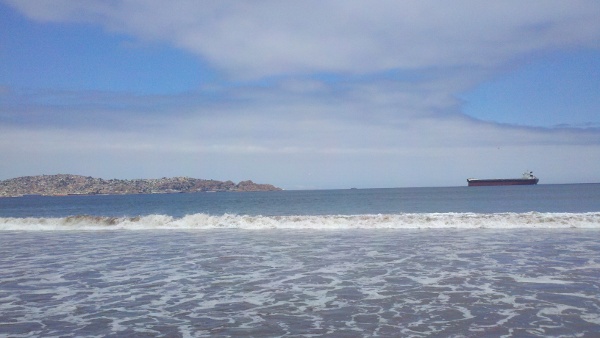
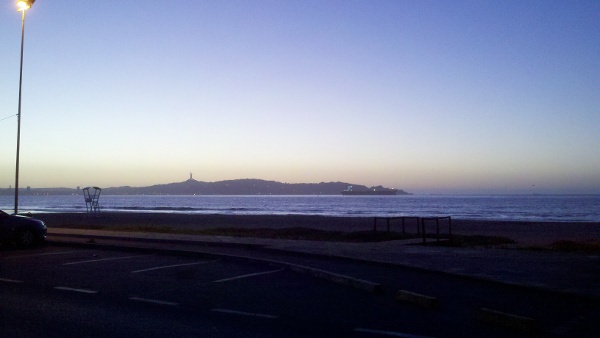
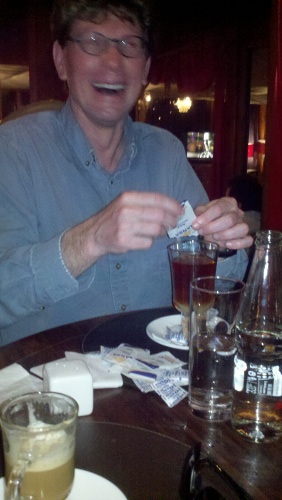
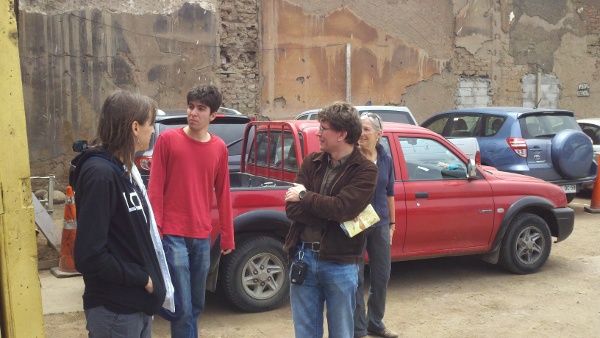
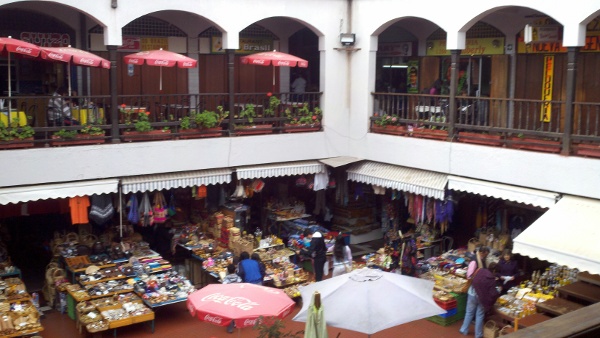
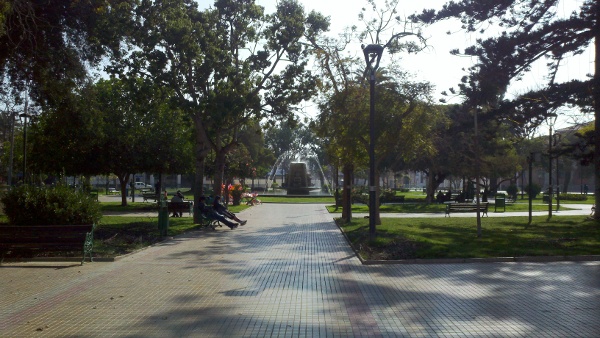
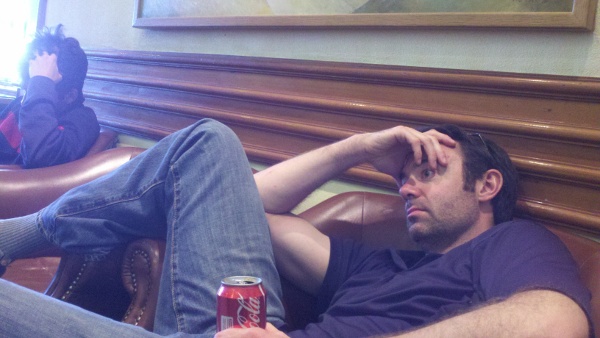
We stayed in the beach town Coquimbo, right next to La Serena.After a relaxing day of snoozing, exercising, and enjoying the beach, we headed out on the town.After a wonderful dinner, Laird asked if anyone had extra sugar packets for his te'. The entire table contributed.The official MagAO hotel in Coquimbo is the Casino Enjoy, which is right on the beach. None of us are big gamblers (Tyson left a week ago), but we did visit the floor to see what was going on. Here Katie poses next to a patriotic slot machine.After a good party and a long sleep, we went into La Serena and played at tourist. Here we're waiting for Laird's dad Nick to park the car.We hit La Recova, a place to buy local wares. Lots of Christmas shopping was accomplished.The Plaza de Armas of La Serena.We are on our way home now. We've made it as far as the admiral's club in Santiago. TJ and I are looking a little fried here - been a long trip.
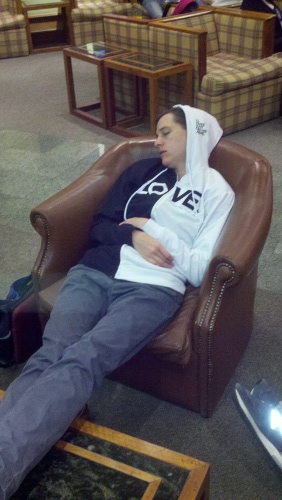
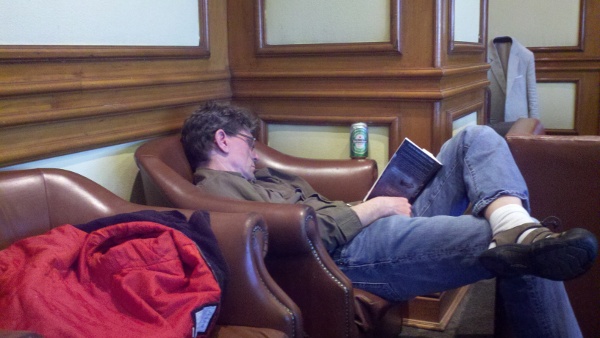
Katie Morzinski, Sagan Fellow, passed out in Santiago. The PI catches some z in the Santiago admiral's club. Might as well start catching up early.
We have a long overnight flight to Dallas ahead of us, but we’re almost home.
Some quotes from the last couple of days:
“Can you guys stop talking?” – Katie (to Laird and Jared)
“I gotta admit, I like strawberry margaritas…yes, I want a margarita, but do you have strawberry? Damn. Ok, just give me the fruit.” – Laird
“We all have these subtle emotional IQs, and because we’re astronomers we’re all a little screwed up.” – Laird
“Laird is a bright boy.” – Jared, quoting Tibor, a friend of Laird’s dad and occasional MagAO fellow traveler.
“LCO is a great place, if you’re into guys, right Katie?” – Laird
“What are you doing in my room?!?! I’m El Presidante!” – Laird (the maids at Casino Enjoy can be . . . persistent)
“Between scotch and fruit cups there are many layers. And one of them is raspberry mojito.” – Katie
“It’s ok. I’m American.” – TJ, to a policewoman.
“Bear Down!” – random stranger, to TJ and his A jacket.
This is my least favorite part: packing everthing up, getting organized, finding all of our lost allen wrenches, and taking a zip-tie inventory.
The PI stumbles into breakfast after our last night on sky.
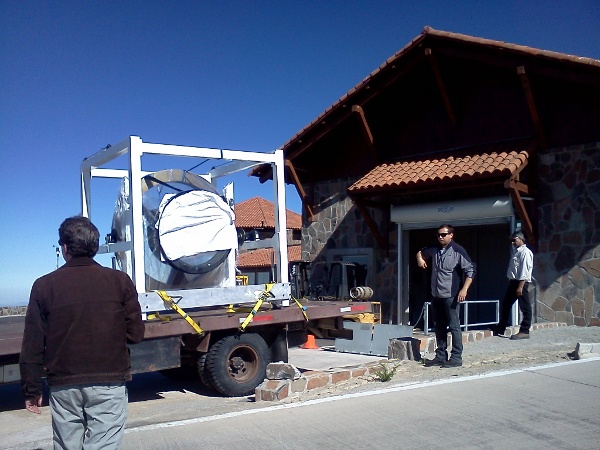
The ASM came off the telescope yesterday, and rode down the hill first thing this morning.
The MagAO ASM backs up to the clean room, where it will sit safely waiting for us to return in March, 2013.
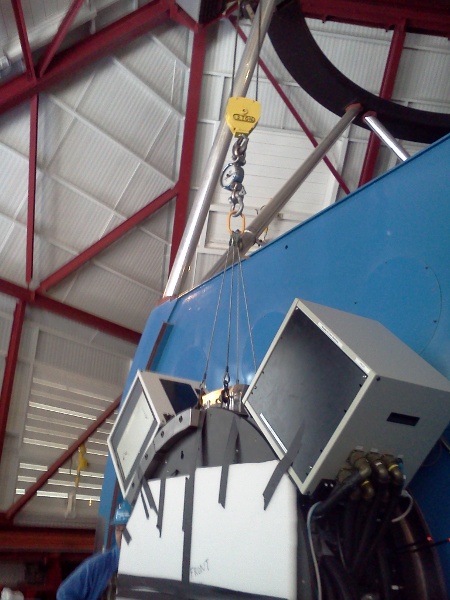
The last major operation was to unbolt and crane the NAS off the telescope.
Juan reviews the NAS removal procedure before we start.Laird untangles our NAS lifting harness. Every single member of the project has fought this contraption at least once, and lost . . . miserably.The NAS weighs 1800 lbs (remember? that's why we buy C/75 steel toes) so the crane picks up that much weight before we remove the bolts.
Once the NAS came off, we got a look at the W-Unit for the first time in a few weeks. Here’s our wollaston beamsplitter, which helped deliver some amazing SDI science at visible wavelengths.
The VisAO SDI Wollaston beamsplitter. The elevator is voice activated.
Kate, who is using the VisAO SDI mode to study disks around young stars, had never actually seen the fully assembled instrument before. Here’s a picture of me and Kate after a quick tour of the components she’s been operating the last few nights.
Jared and Kate looking happy with VisAO as they help take it and the rest of the NAS off the Clay telescope.The NAS heading down on the elevator, on its way back to its parking spot in the Aux building. See you in March!
We also cleaned up some of our, shall we say, less rigorous engineering solutions.
Katie with one of her many significant contributions to the project - our power cord protector. Alas, this has been scavenged and returned to service as packing material for Vizzy's monitors.
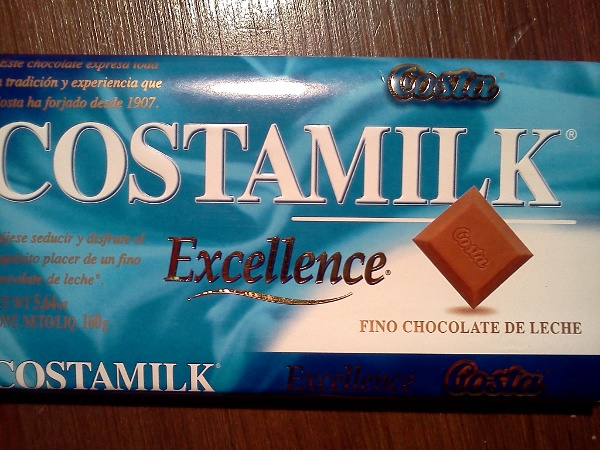
Laird’s folks happened to wander by today (why are you surprised? it’s not like we’re on a mountain top in a remote area of South America or anything). As is his wont, Laird put them to work settling the ASM into the clean room. I hear they helped flip it back to zenith. Perhaps even more appreciated was a chocalate fix for certain members of the team who didn’t plan very well.
A welcome change from Chilean oreos. Don't get me wrong, the cookies are great. But this is day 27.
Quote of the day:
“We should come up with something that looks less like garbage. I mean, it’s well decorated garbage. But.” – Povilas Polunas.
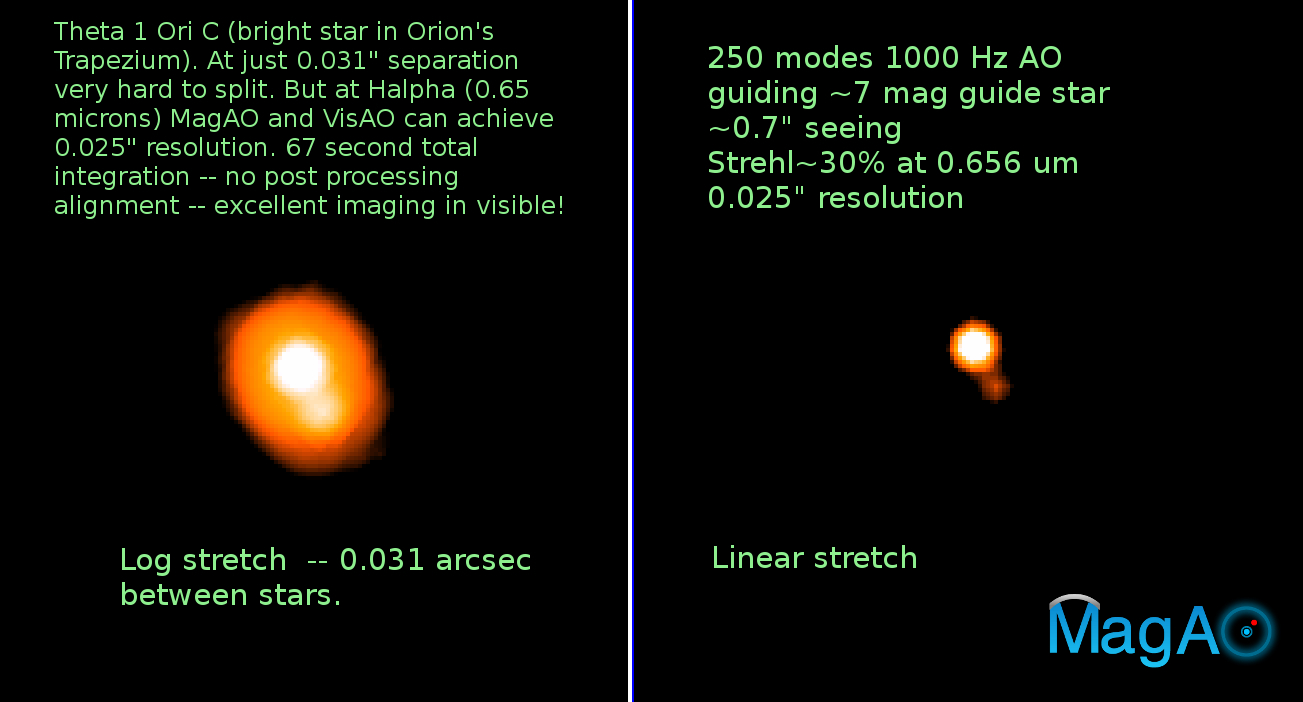
Things are always exciting here on the MagAO project. But nothing – not earthquakes, viscacha attacks, not even non-orthogonal basis sets – can keep us from doing what we came here to do. Now that we are on-sky, we are taking advantage of the *amazing* 0.5 arcsecond seeing common at LCO to take some nice pictures. Last night we were looking at the Trapezium cluster to calibrate our plate-scales, and we took a few moments to take this image:
MagAO/VisAO image of Theta 1 Ori-C, a 31 milli-arcsecond binary system. This is one of the highest resolution astronomical images ever taken. Click for even higer resolution!
We didn’t cheat – no shift and add or other tricks.
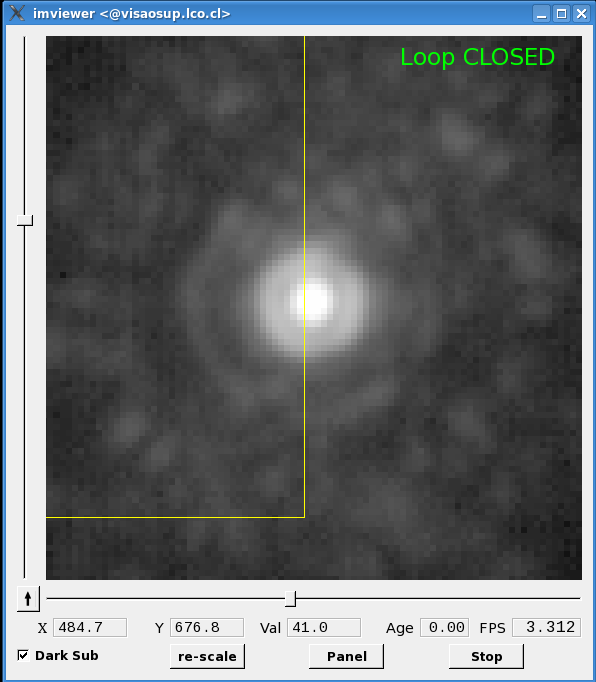
After we solved last night’s communication problems, we did some engineering work, specifically getting Coma-offloading to work. I hate rotation matrices. Later, seeing calmed down, and we took some fantastic images. Here’s a screen grab from VisAO working at 0.982 microns. It’s a log stretch, and captures a single 0.28 second frame on a bright star.
We haven't fully reduced this dataset yet so I don't have a Strehl ratio for you. Let's just call it really damn high for 1 micron, okay?
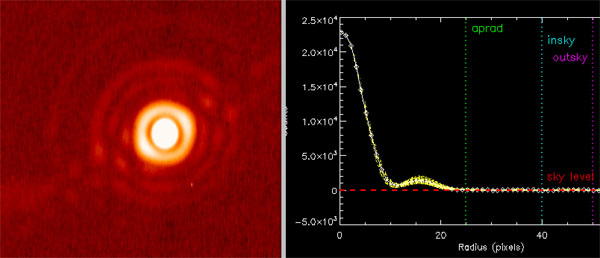
And here’s our M-band PSF from tonight:
M-band PSF
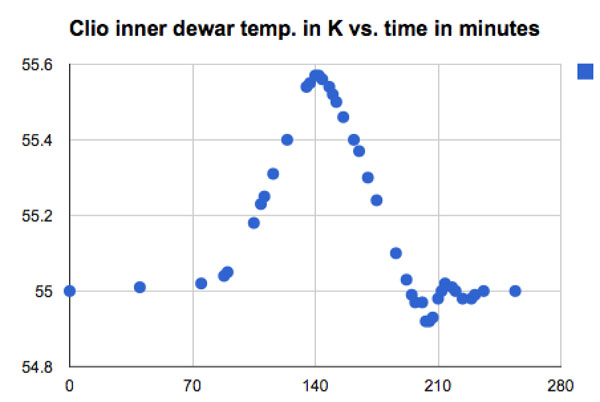
We tested turning off the Clio pump to reduce vibrations in the 25-milli-arc-second VisAO PSF. But since the Clio folks were observing at M-band, a 0.5-degree increase in temperature of Clio’s inner dewar caused a 3% increase in their thermal background. Therefore, we turned the pump back on again, and the sky background settled back down as the detector cooled. Here’s a curve showing the effect on Clio of turning off and on the pump:
Temperature (Kelvin) vs. time (minutes) of the inner dewar and detector of Clio. At time 0 the pump was turned off, to try to remove vibrations from the VisAO PSF. 140 minutes later, the pump was turned back on, because Clio's M-band background had gone up by 3%. There is a little bit of an overshoot as it cools down, and then the heater comes on to stabilize the temperature at 55.0 K.
Runa Briguglio, who is here from Florence helping us take care of the shell, suggests that we operate by this guideline:
Our new guideline.
Some quotes:
“If I’m doing what I think I’m doing, I’m an idiot. Yes! I’m doing what I think I’m doing!” – Glenn Eychaner, who came up the mountain today just to help us debug our TCS-MagAO communications problem. Thanks Glenn!