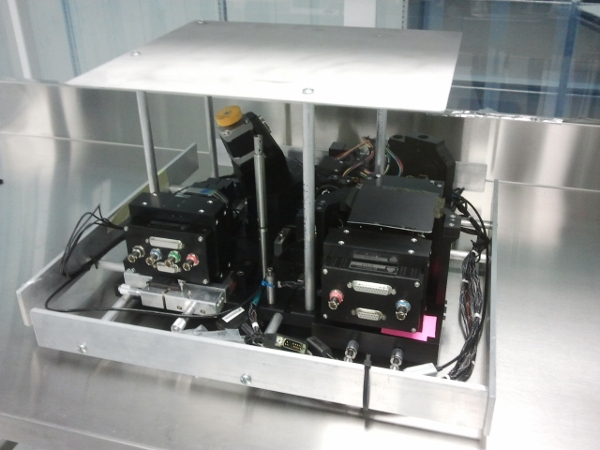
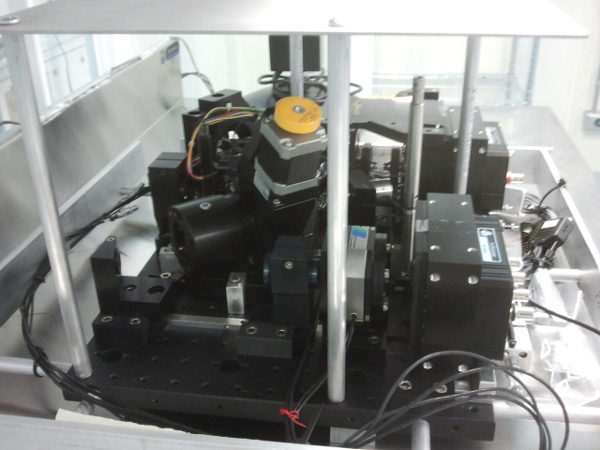
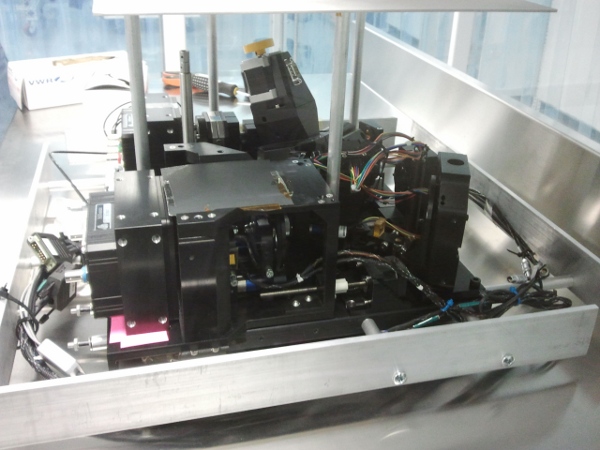
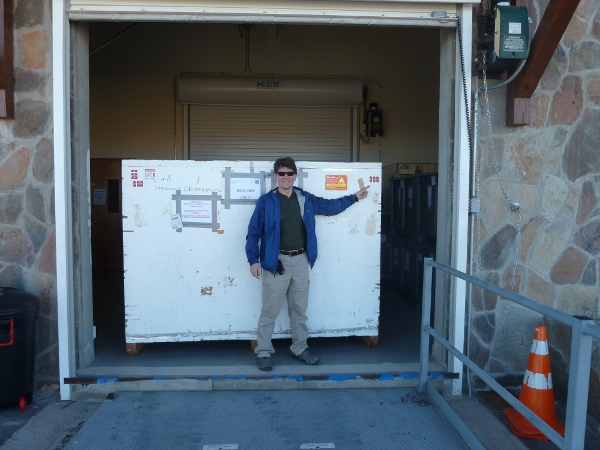
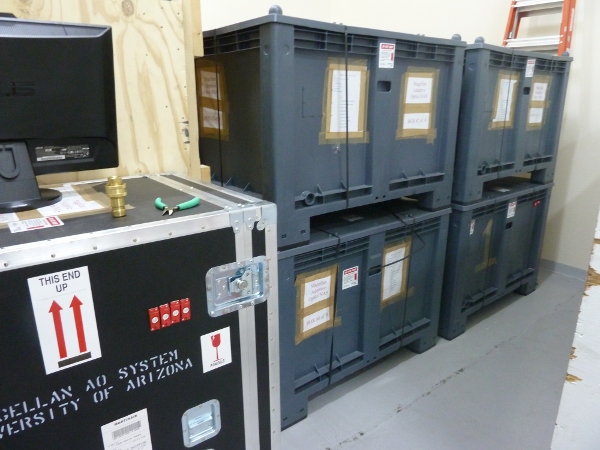
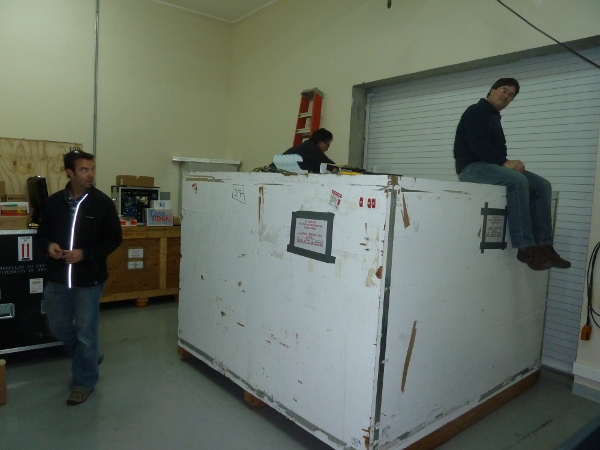
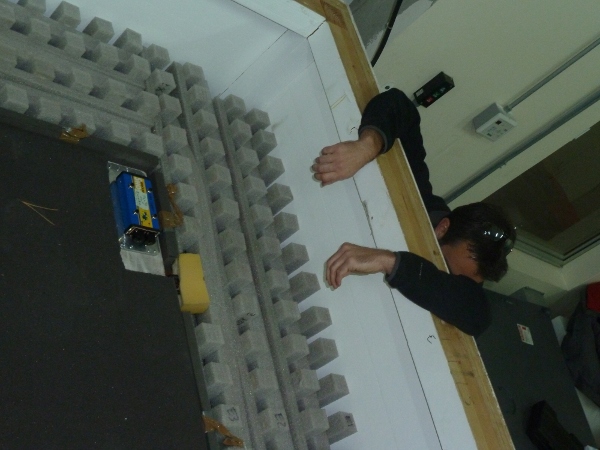
More progress at LCO today. The ASM unit was unpacked and moved into the cleanroom, the mount ring was attached to the ASM handling cart, the finishing touches were placed on our guider, assorted other odds and ends got checked off, and the Arcetri component of our team arrived. Now on with the show:
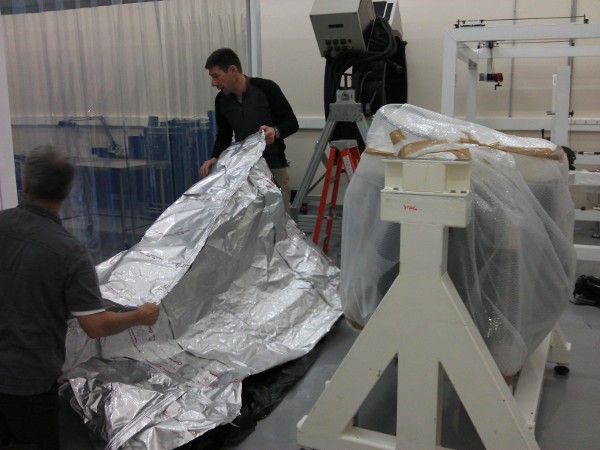
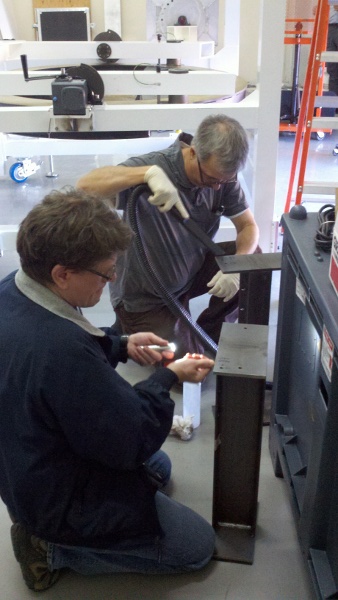
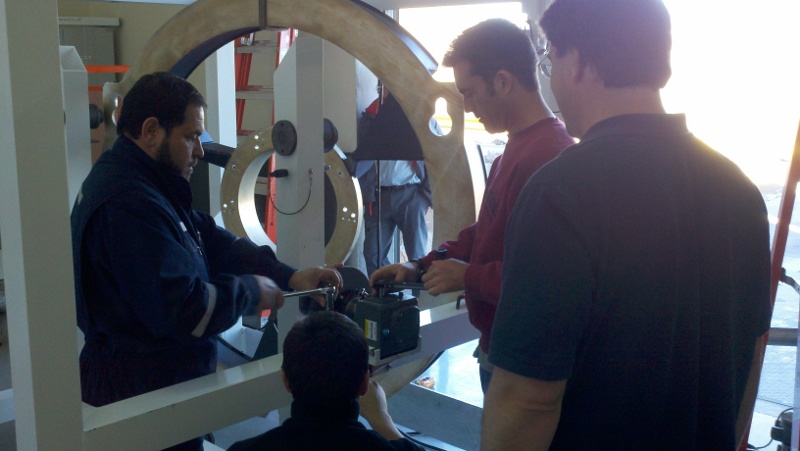
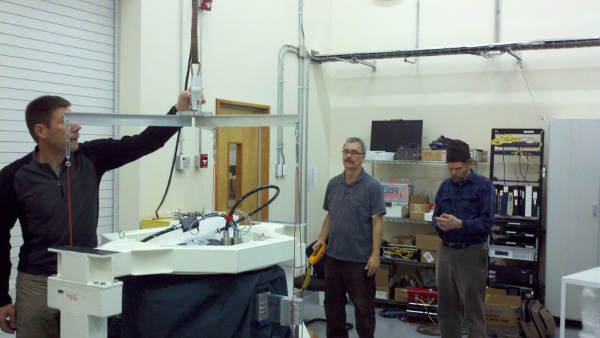
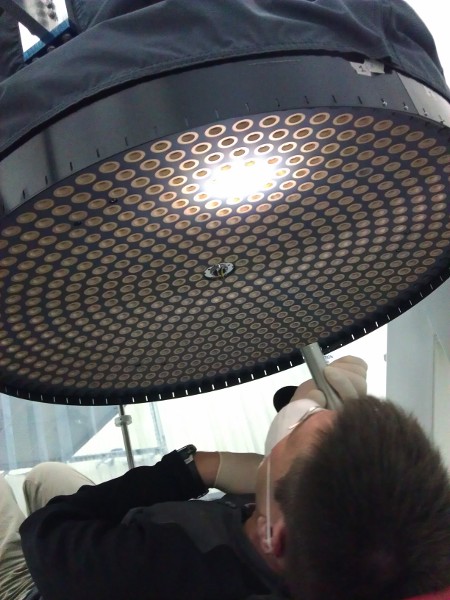
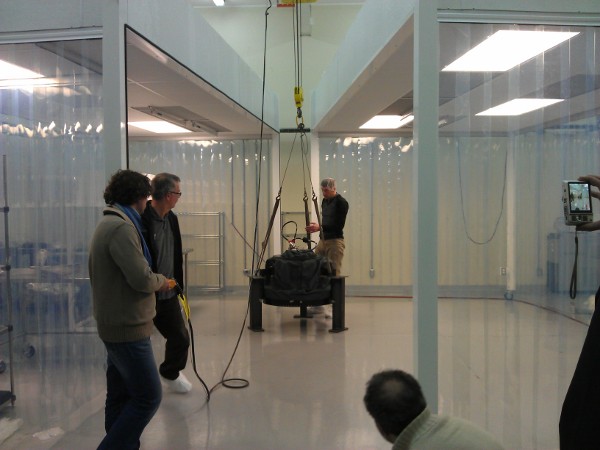
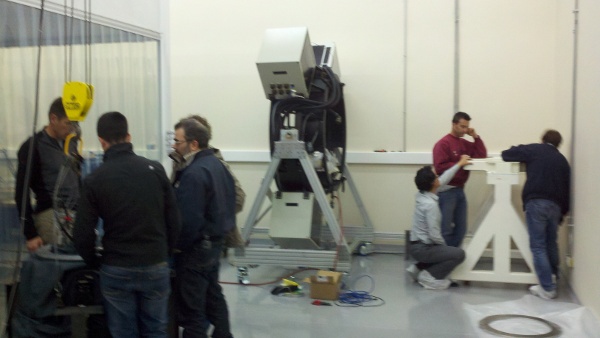
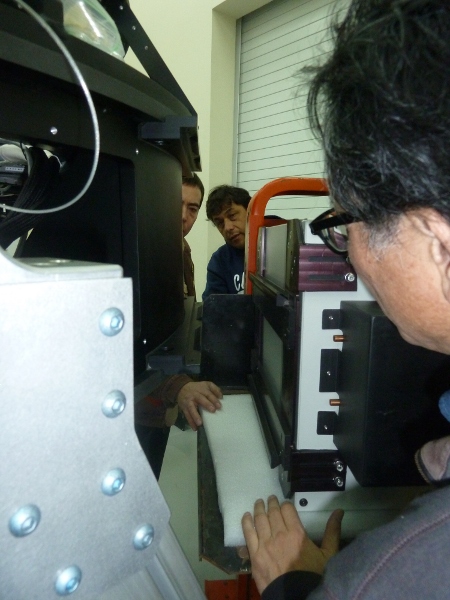
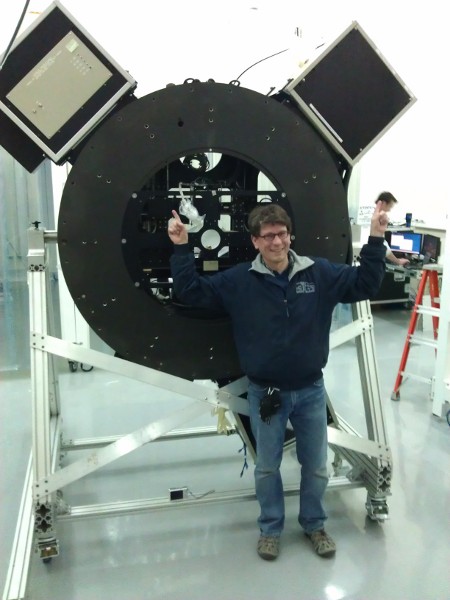
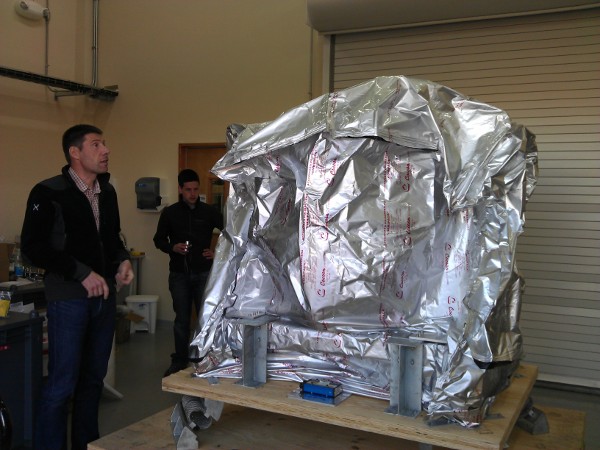
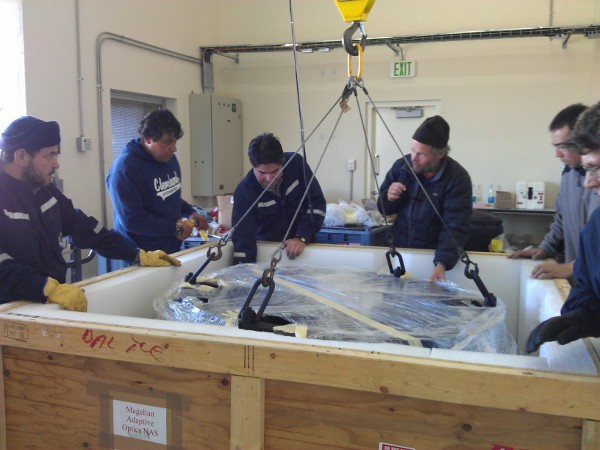
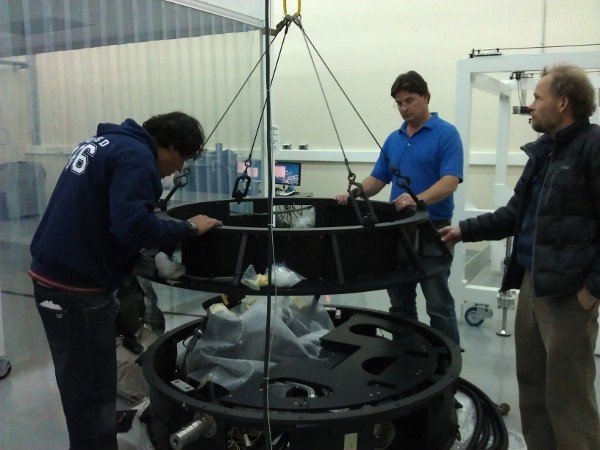
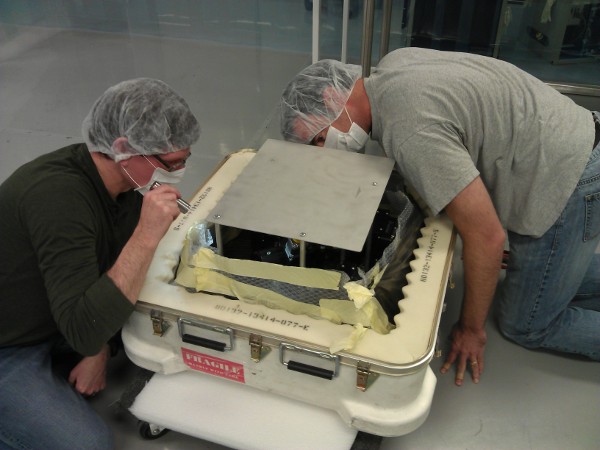
Mario and Richard removing the shipping cover from the ASM.Laird is de-burring one of our ASM feet, and Richard is vacuuming another one.A few modifications were necessary to finalize the ASM handling cart. Miguel, Juan, Tyson, and Victor are adjusting the gear box.Tyson Hare working on the ASM handling cart. It's his baby.Mario, Richard, and Povilas preparing to move the ASMMario inspecting the ASM reference body. It looks great.At the end of the day the ASM was moved into the clean room for safe keeping. All work on it will be done here from now on.
This video shows the ASM being moved into the clean room.
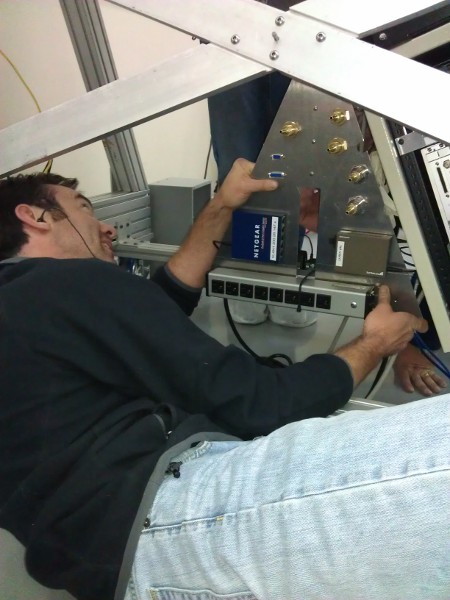
This is our new cable bulkhead, being test fitted on the NAS. All of our cooling hoses and electrical and communication cabling will route through this plate.
We hit another snag today. Our “wedge plate”, which is part of the mounting system which holds the ASM on the telescope, was found to have been made with a set of holes clocked by about 60 degrees. This is an easy thing to fix – we’ll drill new holes tomorrow.
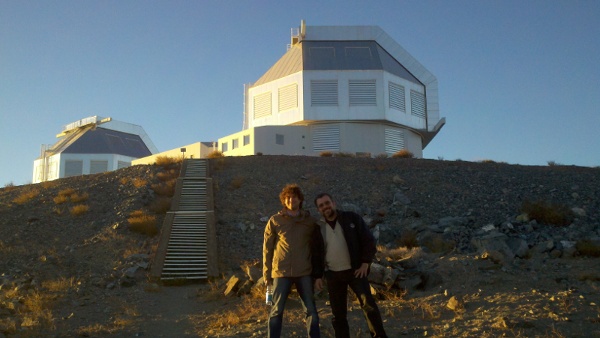
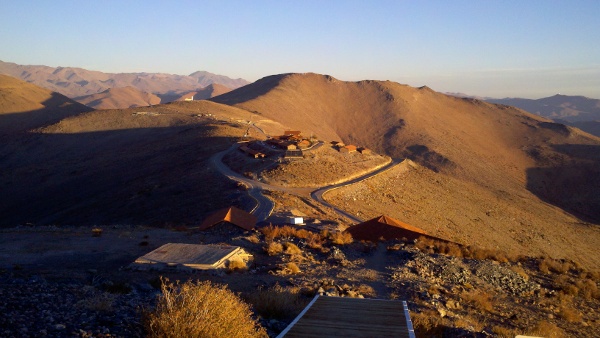
Shortly after discovering the clocked holes in the wedge plate, the MagAO team spontaneously formed committees and began problem solving. Armando Riccardi and Marco Xompero arrived today from Firenze, It. They are here to help us with our thin shell and handling the ASM. They're the world's best, so we're in good hands. Here is our daily shot of LCO itself. Center frame is the dorm complex, where astronomers and staff sleep, eat, workout, do laundry, etc. In the foreground, the left hand rooftop is the cleanroom where MagAO is hard at work. At right is the Astronomer Support Building, which among other things contains the nearest coffee pot.
Another eventful day here at Las Campanas. Some more of the team arrived: Richard Sosa from Steward, Tyson Hare from Carnegie (Pasadena) and Mario Andrighettoni and Frederico Piccin from Microgate (Bolzano Italy). We unpacked the flipping bench, and even more exciting was the first mounting of our 4 electronics boxes on the NAS ring. This also led to our first glitch. After dinner we started unpacking the ASM unit itself. As usual, here are some pictures of all the fun:
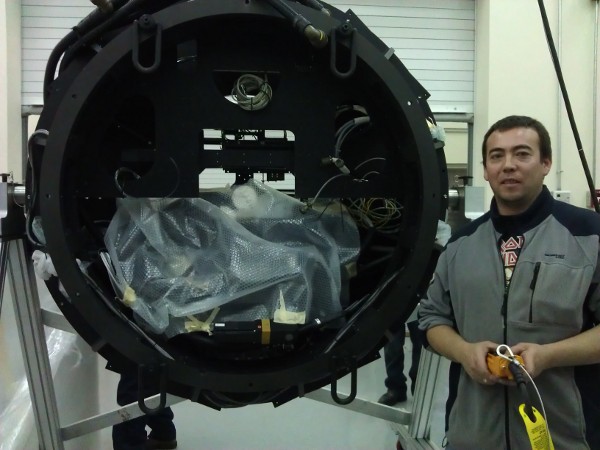
Juan, Emilio, and Alan are mounting the guider box on the NAS. This box holds the control electronics for our guider.The PI celebrates. The guider, driver, and CCD electronics boxes are safely mounted. See below for what happened to VisAO.Mario and Frederico unpacking the ASM unit.
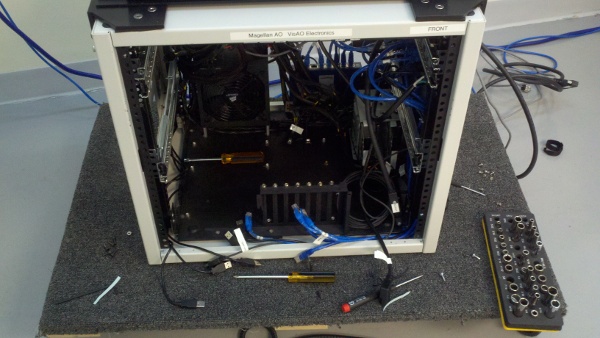
So we had our first glitch today. After mounting the VisAO box on the NAS, we noticed that a box bolted to the side (part of its liquid cooling system) would prevent the NAS from rotating to the vertical while on the transport cart. Even though this is only a problem when the system is off the telescope, we still need to fix it. The fix sounds simple: get a smaller box. As usual, it ain’t that easy. Removing the box meant almost completely gutting the VisAO electronics box. Fun.
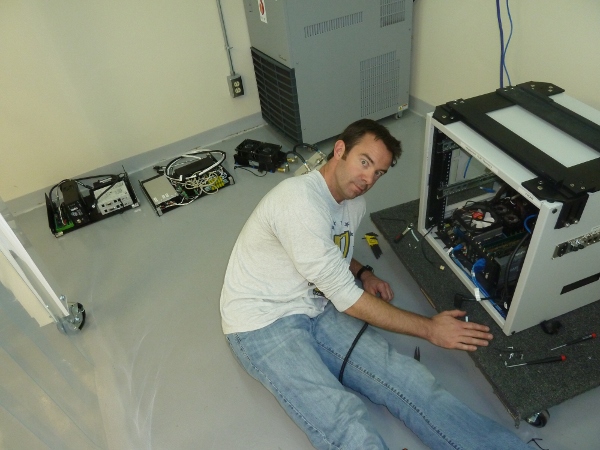
The VisAO box after being gutted. This was necessary to remove the offending cooling equipment.Jared about to express his opinion about something. This is a family blog, so I'll just say that having your advisor tell you to disassemble your PhD project makes for a rough evening.
At the end of the day, VisAO is all back together and working. We’ll mount it on the NAS tomorrow as soon as we get a chance. We also powered up the “Little Joe” CCD controllers today, and verified that they survived the trip. Things continue to go well.
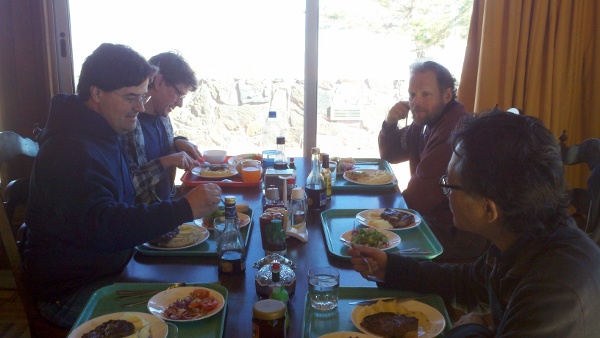
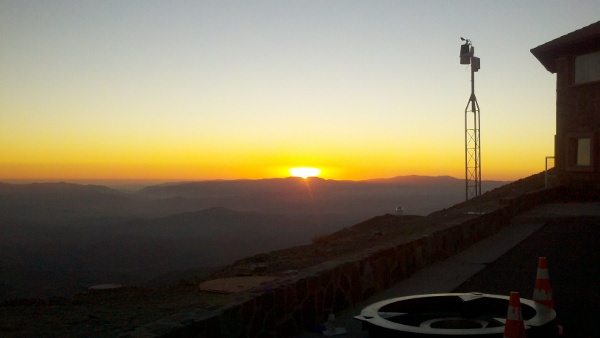
Victor, Laird, Povilas, and Alan sitting down to steak and potatoes for lunch. The food here is great.LCO is a beautiful place. This was tonight's sunset from outside the clean room. Our ASM mount ring shines in the foreground.
We kept at it on our 2nd day (our 1st full day). Today we unpacked the NAS, installed the guider in the NAS (for the first time), unpacked and tested our computers, and after dinner we unpacked and inspected the WFS. Some pix:
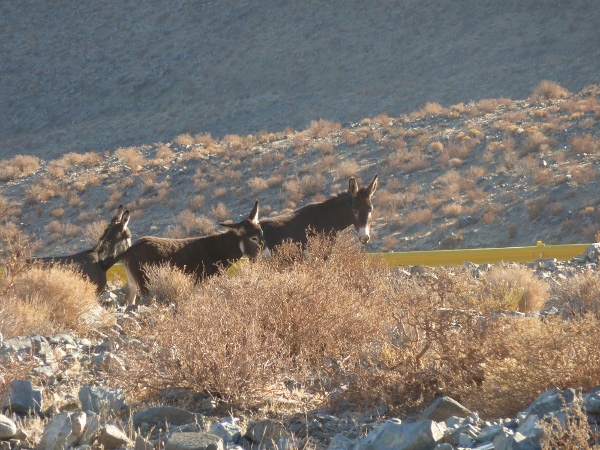
Here we are about to lift the NAS out of its box, the whole team is making sure nothing goes wrong.Lowering the NAS down onto its cart.The spacer ring goes back onto the NAS after the guider is installed.Juan finishes tipping the NAS with the crane.Laird and Jared inspecting the WFS immediately after opening the shipping box. Everything looks good. Before anyone asks, yes the T/T mirror is still attached to its stage. A rare view of the back of the WFS with no cables. CCD 39 at left, CCD 47 at right.The pyramid sensor side of the WFS - all looks good.The VisAO arm of the WFS - all our special filters look unharmed.A herd of asses.
Today, for the first time, all of the MagAO system was on the same continent, and even in the same building. On top of that, after a 50 hour odyssey Laird, Victor, and Jared arrived at LCO to begin unpacking. MagAO is officially at Magellan! Here are some pictures from today.
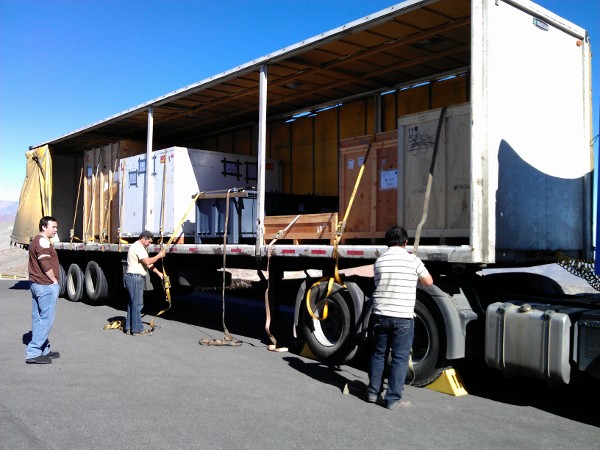
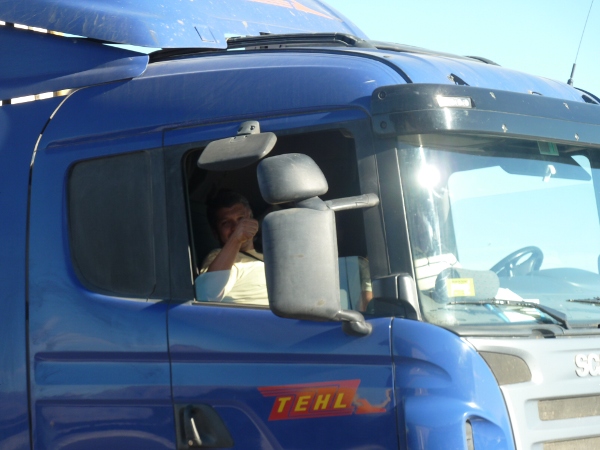
The MagAO ASM arrives at LCOThe conductor celebrates the end of a *slow* drive up the mountain.
Meanwhile, somewhere between Tucson and La Serena:
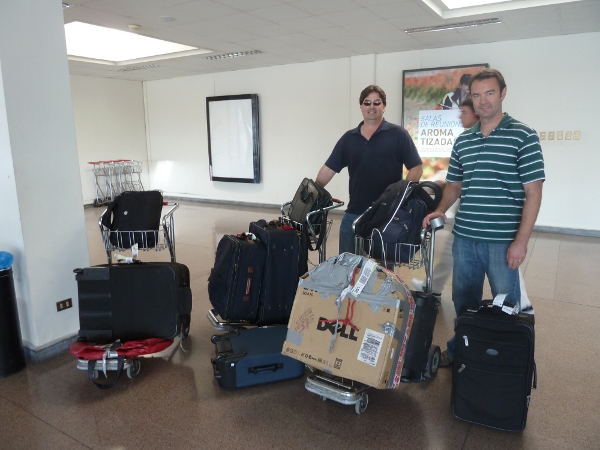
Victor and Jared pose after defeating Chilean customs with way too many parts of MagAO in our luggage.
And finally at the top of the mountain:
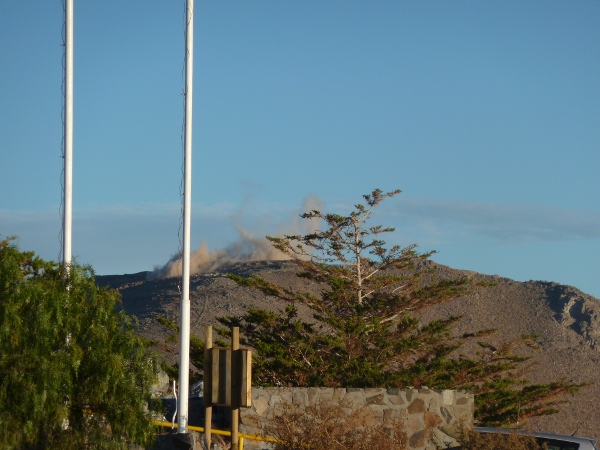
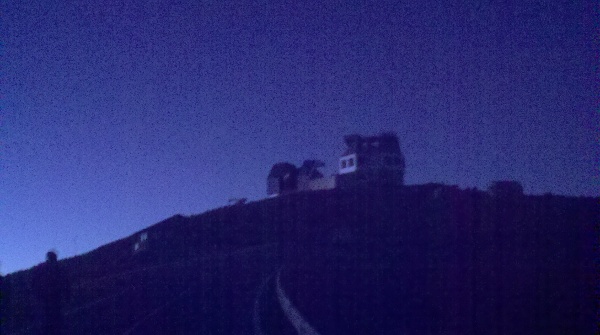
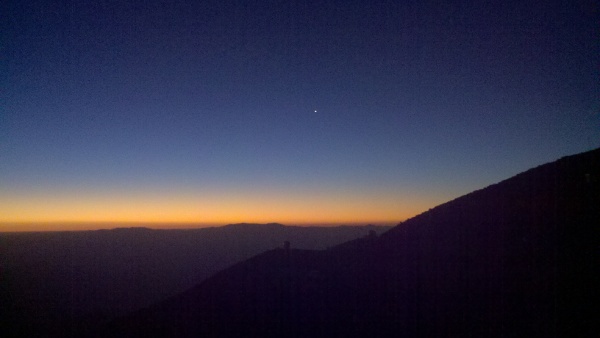
We witnessed a blast for the GMT.Here we see the backup transport system, standing by outside our dorm rooms just in case.Our future home, the Clay Telescope, is the one at left opening at sunset.Venus over LCO. By the way, the stars are weird down here.Laird celebrates the fact that none of the drop-n-tells tripped on the outer box. This means that the shell was handled very carefully on its trip from Italy.Our electronics waiting to be unpacked.Victor and Alan unbolting the top of the outer box.Jared expresses his opinion about something. Ask me later - it probably doesn't matter. Update 4 days later: it didn't matter.We only tripped 2 of 3 5g drop-n-tells on the inner box. This is a great sign that our delicate shell was treated well on its journey.Here we're moving the inner box. Jared is operating the crane, and Laird is guiding the load. Victor guides the inner box and its delicate contents down. The foam behind him was on top of the inner box.
At the end of our first day the inner box was safely stowed in the clean room, and we have started unpacking our electronics. A big first day.
The NAS and all the W-unit and VisAO electronics landed in Chile early on Tuesday morning. The first part of MagAO has now arrived in Chile!
Our other big news is that the ASM – meaning the thin shell itself and the ‘unit’, which means the reference body and attached electronics – has left Arcetri and is on the way to the airport in Firenze. This process will take a few days for customs etc. The pictures below, courtesy of Armando Riccardi, show the final stages of packing the ASM and loading it on a truck.
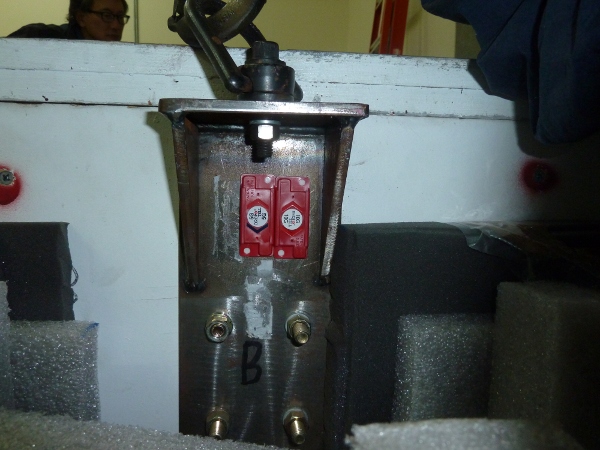
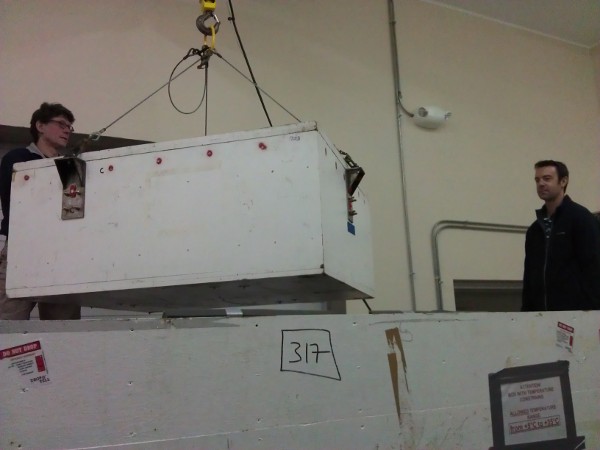
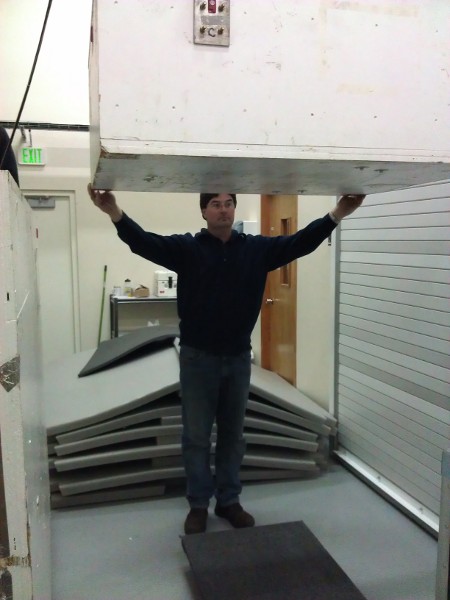
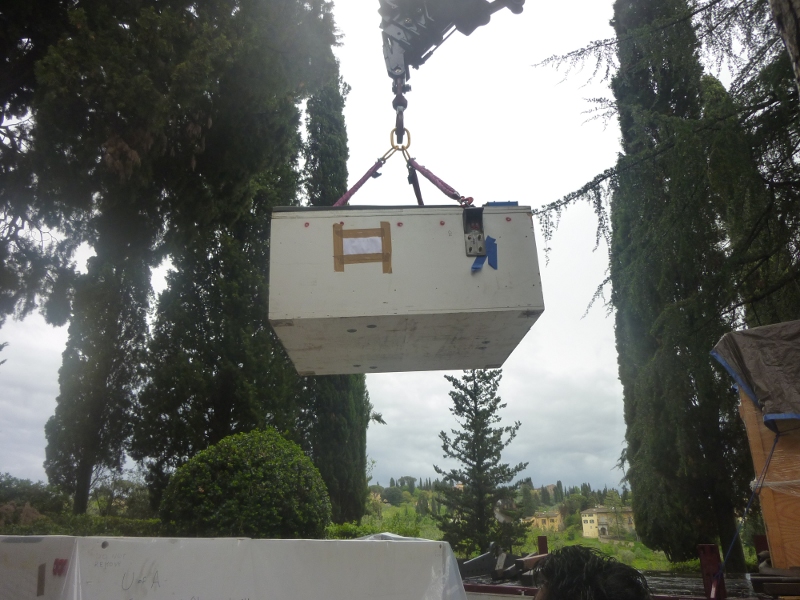
Our mirror is swinging through the air! This is the "small box", containing the 85cm wide by 1.5mm thick thin shell of our adaptive secondary mirror.The "large box" being loaded on to the truck. The "small box", shown above, is packed inside this box. This system is carefully designed to protect our delicate mirror during the flight.Here we see the reference body and electronics being readied for packing in their shipping box.