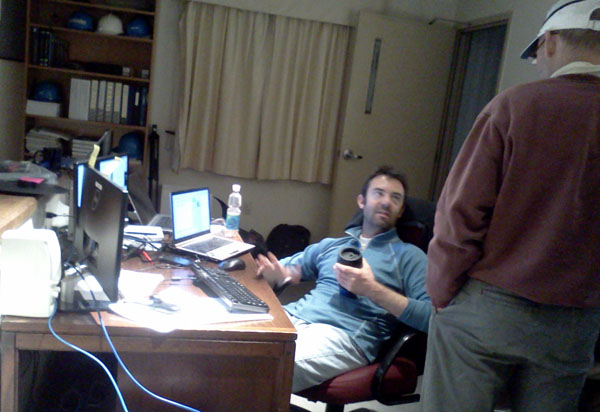
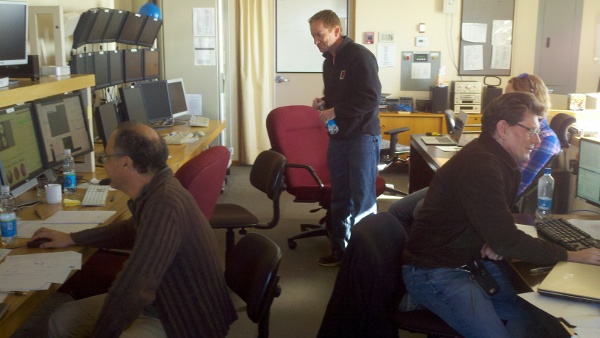
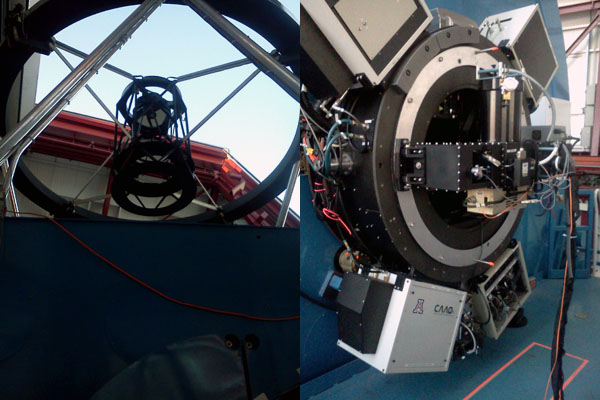
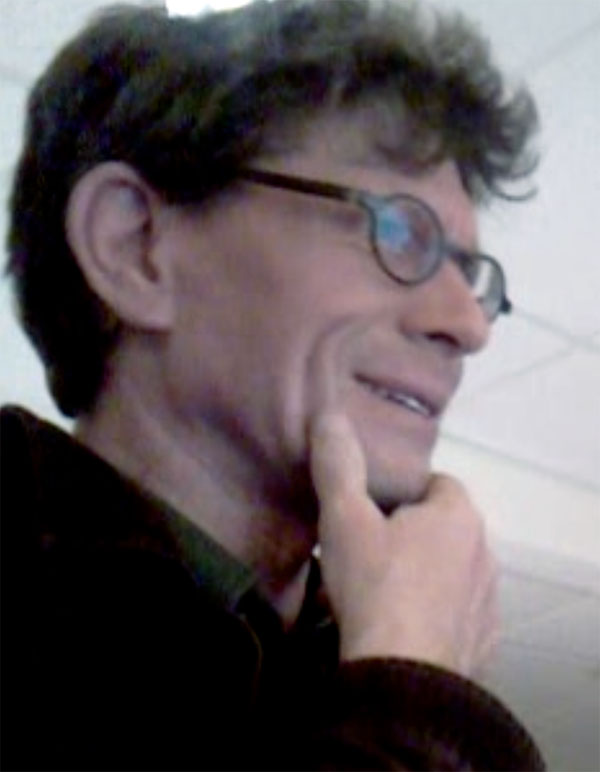
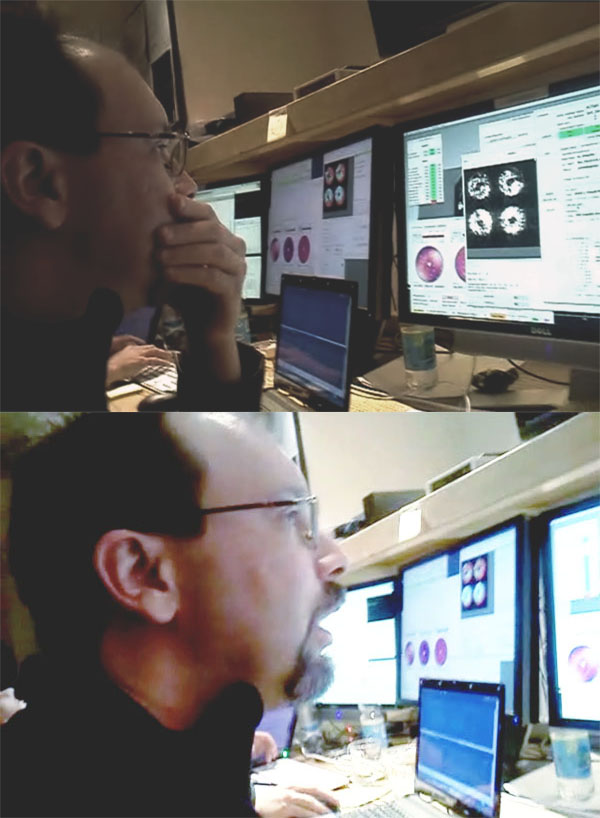
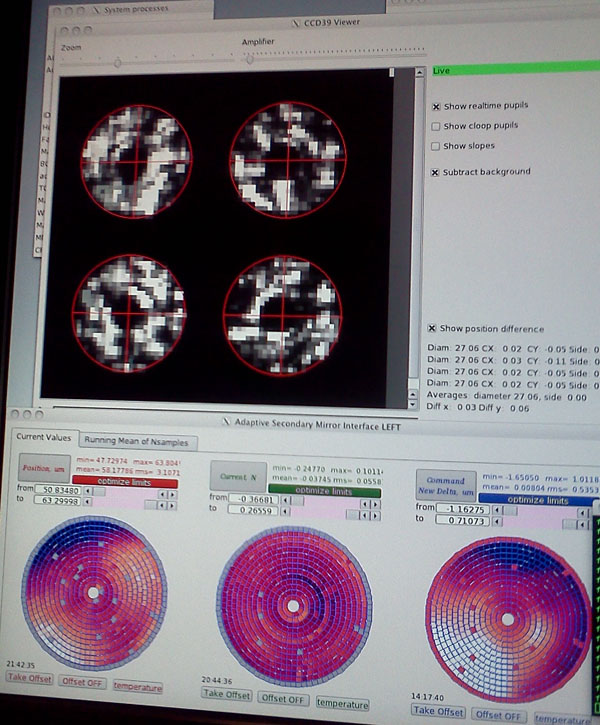
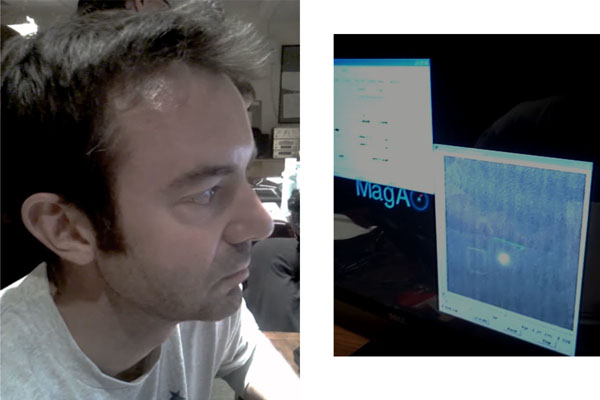
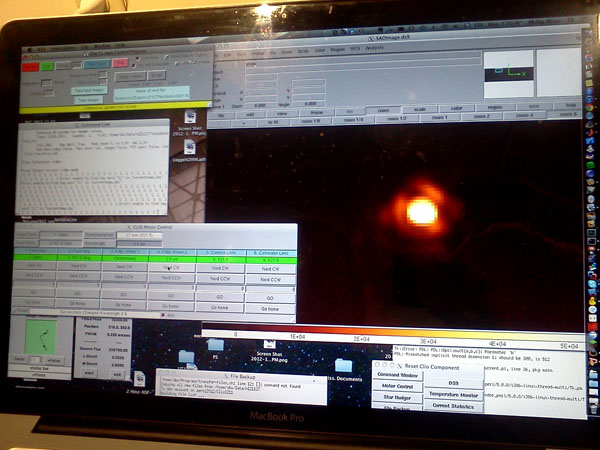
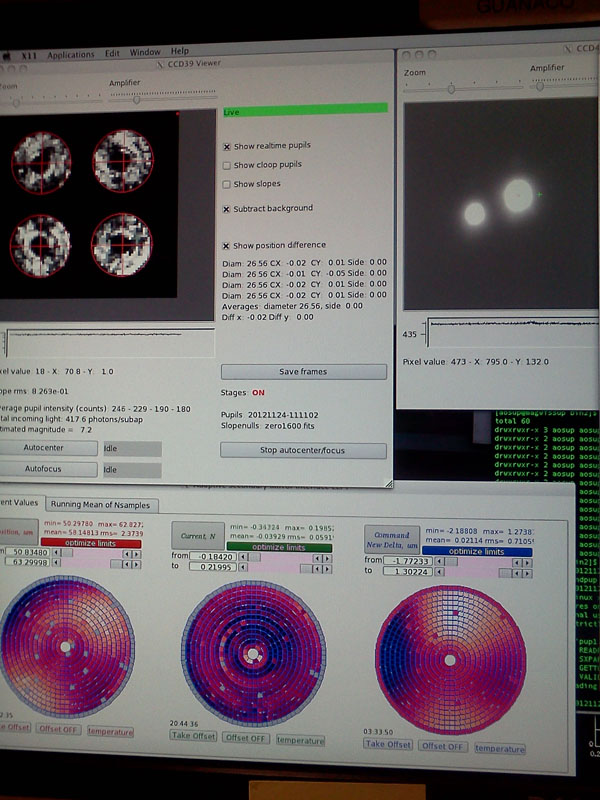
Tonight started with a hard to understand communications problem between our AO system and the telescope control system (TCS). It’s been working for days, but tonight we started having some messages get dropped. We have to keep the elevation of the telescope above a certain value to keep our delicate mirror safe, and this communications problem was causing us to stop getting elevation often enough. So our mirror RIP-ed, which means rest-in-peace. We don’t know what’s going on, but we hacked our way out of it by changing some timings. Troubleshooting begins again tomorrow after supper – I can’t wait.
Jared and Povilas working out some AO to telescope communications
After that, we had a very productive night. We looked at a standard star to calibrate our filters, and also looked at some well known clusters of stars to calibrate the plate-scales of our camera. Both cameras also had their foci checked. Kind of boring scientifically, but it’s important that we characterize our new instruments on real stars.
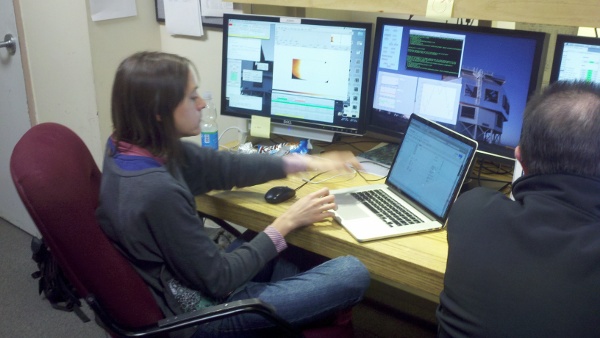
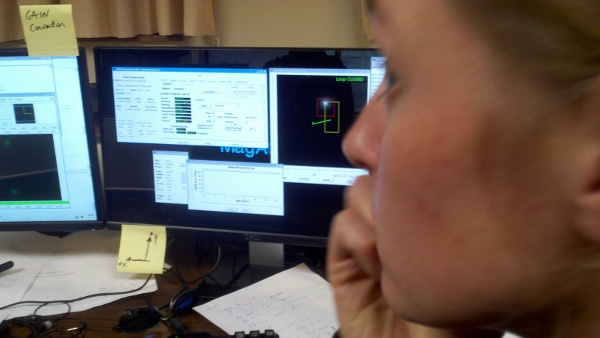
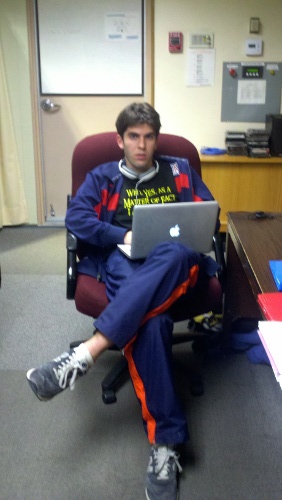
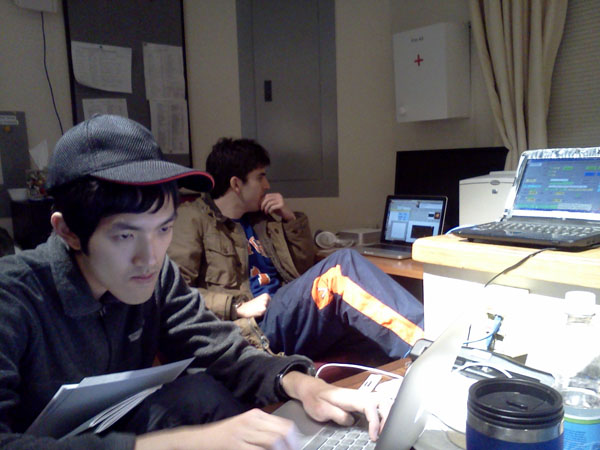
Katie getting Clio where she wants it.Kate got a bunch of SDI data tonight.TJ reducing data on his lap.
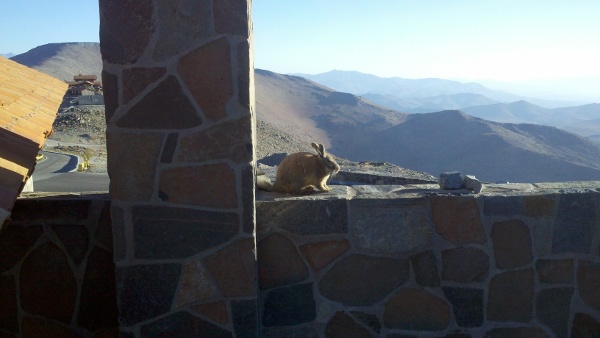
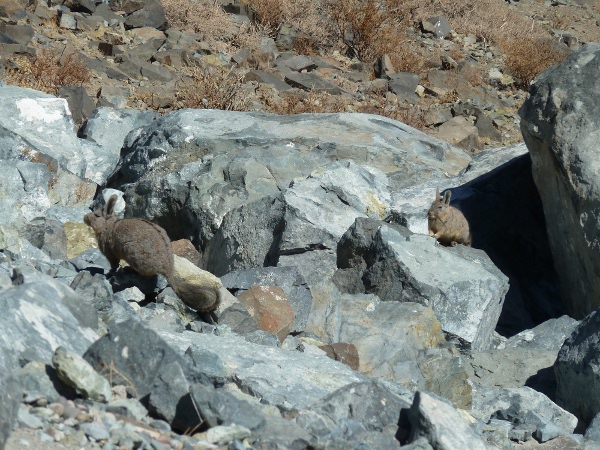
Katie and I were charged by a Viscacaha on our way down the mountain this morning. They’re turning against us.
This is one of our "tame" ASB friends. One of the "wild" ones ran straight at us this morning, and swerved at the last minute. They can really move.
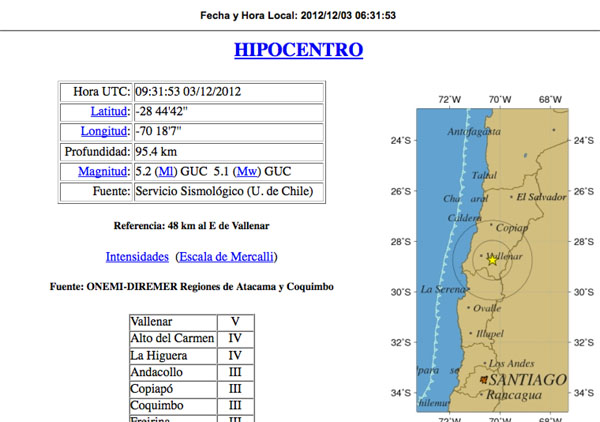
And as I’m typing this we just got hit with an earthquake:
5.2 earthquake at 150 km, 6:30am
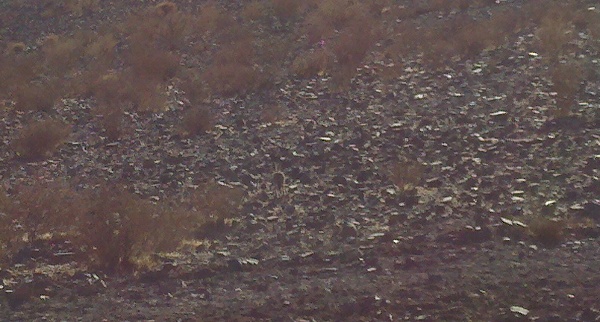
We also saw a hare this morning, a MagAO first.
A hare running through the rocks. Try hard.
“I’m a fan too, not just your families. I miss viscachas.” – Prof. Dan Marrone, captain of the Steward Observatory softball team and MagAO enthusiast.
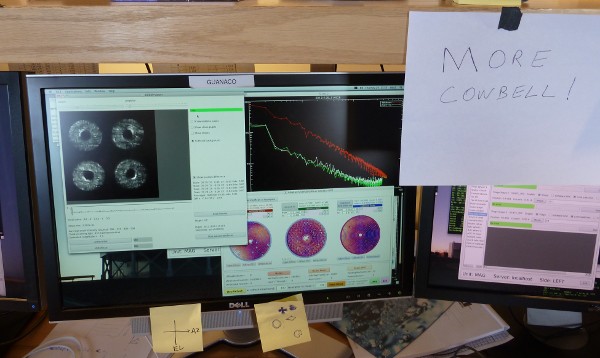
The unofficial battle cry of the MagAO project over the last few days has been “More Cowbell!” as we try to get a high-order basis set that keeps our actuators happy.
Will this basis set work? Stay tuned.
To get the truly amazing image quality that our system is capable of, we need to find a set of shapes for our mirror that is stable on sky. We aren’t there yet, but we also need to test what we have on real stars to make sure we are on the right track. So we went on sky again tonight, but first we had to pull the CRO.
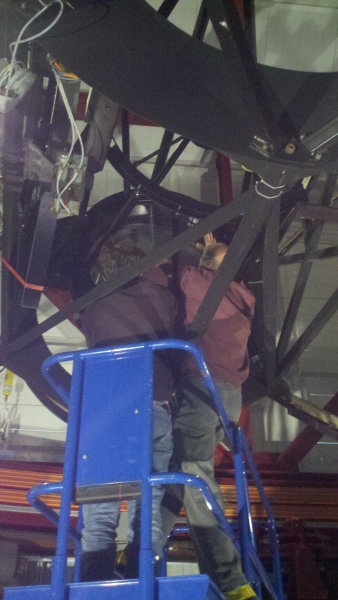
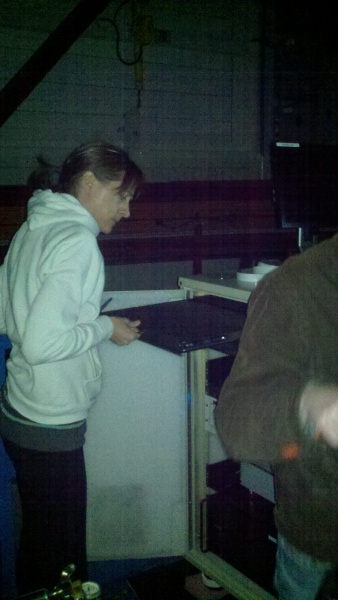
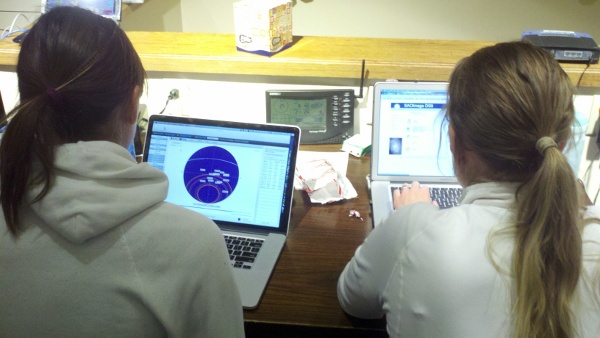
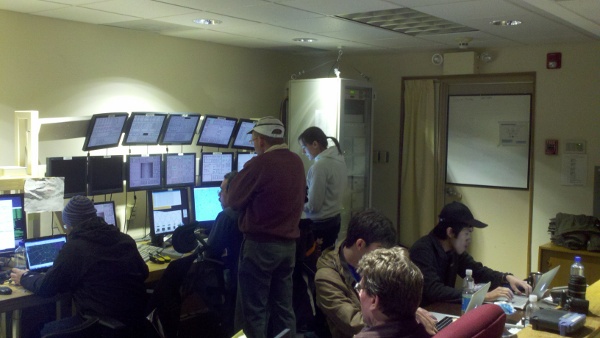
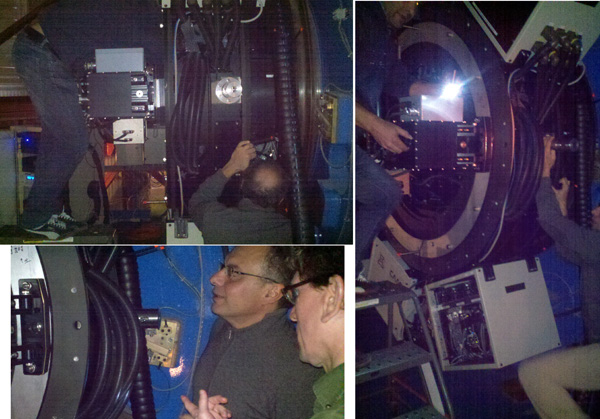
Laird removing the CRO optic from the CRO truss. It's very precisely aligned, so it's a slow and careful process.Laird and Povilas mounting the plexiglass cover that protects the shell when we remove the CRO truss. Sometimes putting the cover on is the most dangerous part.The night started with an in-the-dark checkup on the Clio electronics. Here Katie is opening the rack.Ya-Lin and T.J. hard at work on Clio astronomy -- 100 hoursThe control room of Clay - actually doing astronomy.Since our main goal right now is to test the AO system, we can't predict where we're going to be pointing and what we'll be ready to do, so picking targets is a full time job. Here Katie and Kate are combing the digitial sky for interesting places to look.We're getting our acquisition sequence down. The telescope operator first finds the star, and uses Alan and Tyson's guider to setup the telescope. Then we do a slight offset to put the star on the pyramid. To do this we first use Clio's wide field of view to get the star onto VisAO, then we use VisAO to guide the last few arcseconds. Here Katie is selecting our next target, and Povilas is supervising the telescope setup.
Kate found us a nice quadruple system to check our closed loop image quality:
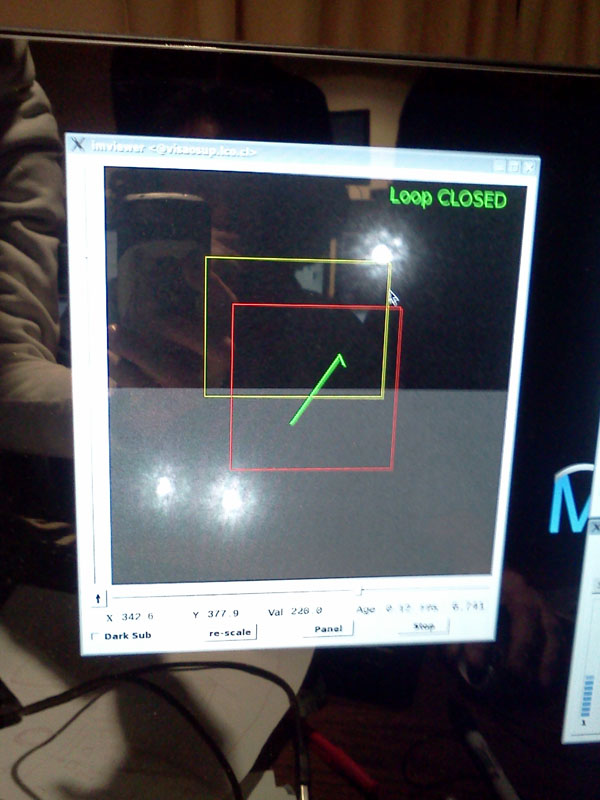
Closed loop image of a quadruple stellar system on VisAO. We resolved the 4th component at only 0.1 arcsecond separation.
Simone and Enrico are leaving this morning. Right before he left, Simone showed me this. Maybe it contains the answer to the riddle: “how do you simultaneously minimize force and maximize rejection?”
The answer.
“I got a fever, and the only prescription is more cowbell.” – Laird Close
After 13 straight days of nearly perfect cloudless photometric conditions, we woke up to this today.
The first clouds of our run.
So, of course, we decided to go on sky for the first time.
Earlier I caught the grown ups attempting to run the system by themselves. That's Simone Esposito actually operating a Pyramid Wavefront Sensor, and Laird Close taking data with the world's virst diffraction limited visible imager on a large telescope. Phil Hinz offers encouragement and advice. I'm pretty sure this was when tonight's plan was hatched.
We haven’t completed all of our internal calibrations, but going on sky will let us see if they are valid so that we can complete them with confidence. Furthermore, there are many other things we can learn by looking at a real star, with a moving-pointing-guiding telescope. To do this, we had to pull off our calibration return optic (CRO), a.k.a. The Crow. We decided that tonight was the night at about 4pm. The LCO crew responded – Juan, Mauricio, and Pato sprang into action to help us pull the CRO and get the telescope ready. So by dinner, all we needed was a sunset.
After a quick chicken dinner, we just went up and closed the loop.
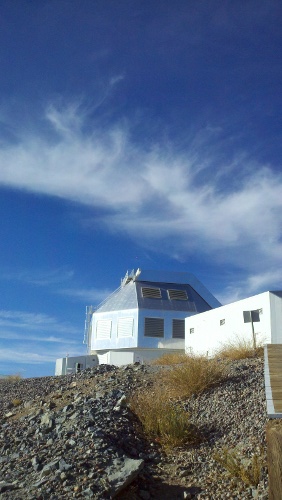
The complete MagAO system under an evening LCO sky.
Ok. It was harder than that.
The PI ponders the possibilities. All of them.Alfio closes the MagAO loop for the first time on-sky.On-sky closed-loop pyramid pupils. The bottom plots show ASM status.Jared with VisAO's first light.First light (at Magellan) PSF for Clio2.Later we looked at a binary. This let us verify that our rotations and platescales are about right.
Thanks to everybody who helped make this happen. We’re just getting started, and there’s lots more to come. Stay tuned!
Some quotes from today:
Laird: “We didn’t come here to get Lucky. We came here to be good.”
Povilas: “We have a situation here, where you’re arguing both sides.”
Simone: “Yes. I’m trying to sound wise.”
Laird: “There had better not be any frisbee tonight.”
Katie: “We’ll never run out of cookies.” (seriously, there are a lot of cookies up here)
Sorry for the tardiness of this post. The internet was down on the mountain when the night shift went to bed this morning. The day was a struggle, but we finally got at least something working, and then did some testing through the night.
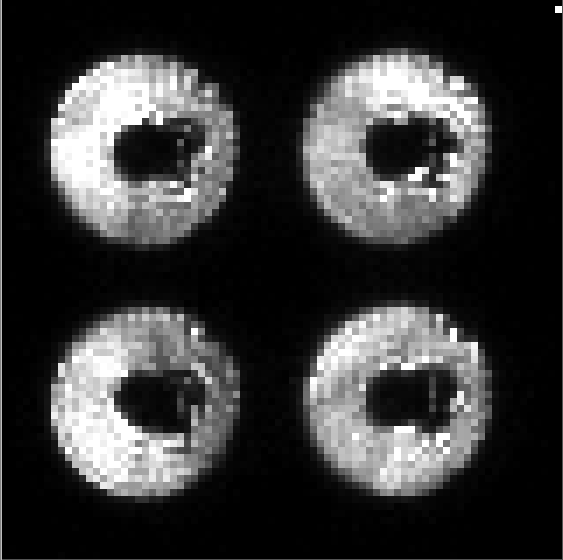
The issue was a feature in our pupil which Simone has dubbed the Viscacha.
Our Pyramid pupils from this afternoon, with a Viscacha head clearly visble.
We tried several things. One quick and dirty modification was to remove the field stop for the Pyramid. Simone and Enrico climbed into the NAS to do this – after first convincing Laird that this was a good idea.
Simone and Enrico perform minor surgery on the NAS.
The day shift ended with a somewhat working 200 mode interaction matrix. So the night shift did some closed loop testing.
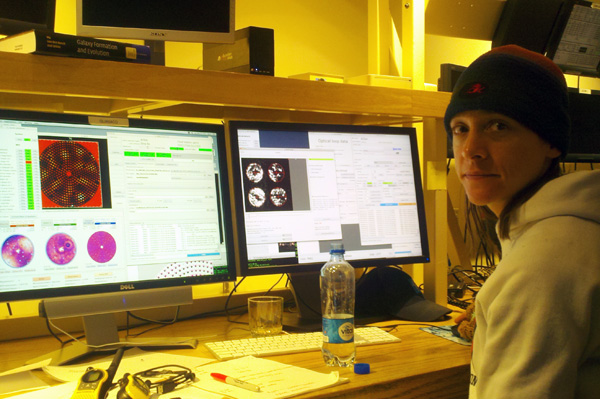
Katie at the AO operator's workstation.
Things are hopeful. With only 200 modes we have a fairly high Strehl ratio PSF. The problem is keeping it stable. These two videos, taken with the VisAO CCD 47 at 32 fps, show this.
Youtube noted that my image was shaky, and asked if I wanted to fix it. F*&!$^ you Google. Here’s the same data set, but keeping only the best 5% of the images (Lucky imaging style).
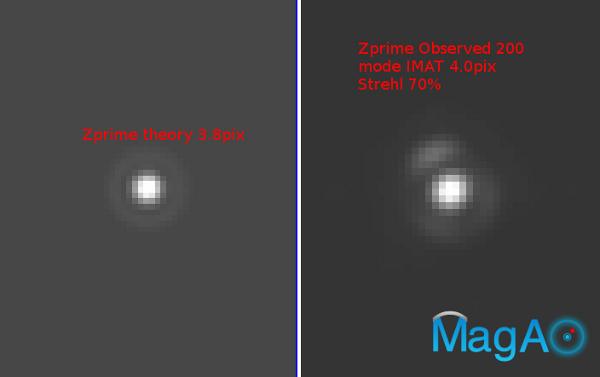
After breakfast Laird reduced this data by “shifting and adding”. Here’s what our images will look like soon:
Our SAA z' PSF with a Vischacha contaminated 200 mode IMAT.
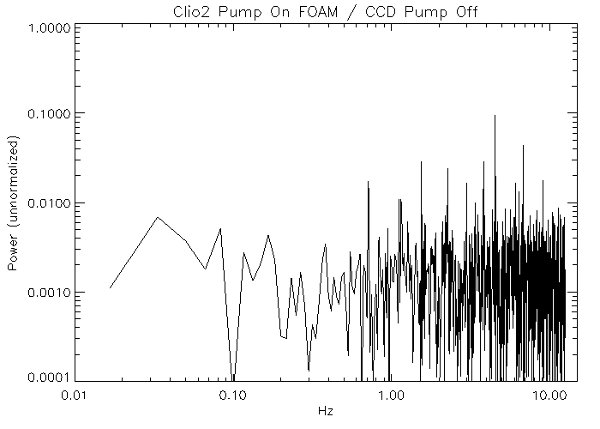
To try to control the vibrations that even Google noticed we put the Clio rack on some foam pads. This improved the power spectrum, at least removing the ~2 Hz spike.
The CCD 47 spot x position power spectrum after putting Clio2 electronics on some foam to isolate the pump.
Quotes:
Simone: “Laird, take a seat. You want to take your seat. I think we need to remove the Pyramid . . . field stop.”
Tyson: “Why don’t you just say you’re a carnivore plus vegetables and cheese.”
Laird: “I thought you were trying to take the frisbee away.” (To Phil, after realizing that Phil was playing frisbee with grad students and the post-doc.)
Phil: “I was just trying to help them meet their 100 hours for the week.”
Simone, on the viscahcha in the PWFS pupil images:
“The viscacha again!”
“There is a clear viscacha.”
“It is not a dynamic viscacha, it is a static viscacha.”
Laird: “It looks like a viscacha that’s been run over by a car.”
Simone: “Yes, but it’s still a viscacha!”
Laird: “I’d really like a headless, tail-less viscacha.”
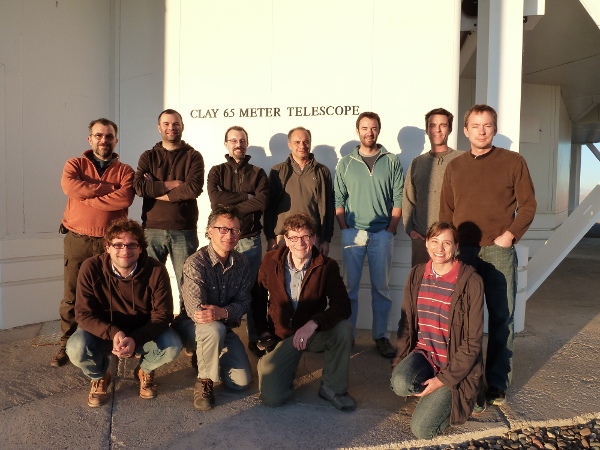
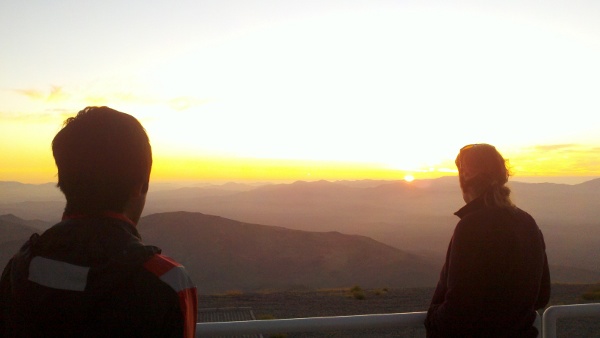
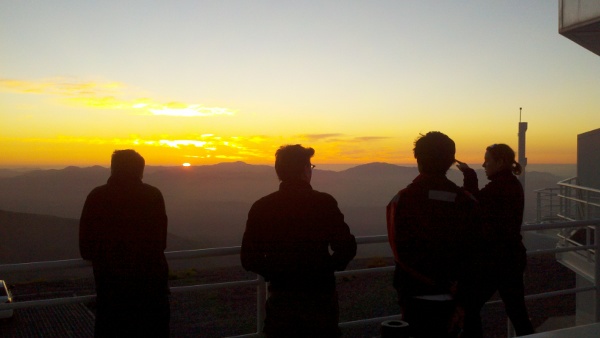
"Wild" viscachas from the backside of the telescopes. Wild as opposed to the "tame" viscachas who live in the ASB.A group shot of the first wave of the MagAO team. Armando left us this morning, so yesterday we gathered the team for a group shot. We'll repeat these as people come and go. From the left, front row: Marco Xompero, Alan Uomoto, Laird Close, Katie Morzinski. Back row: Armando Riccardi, Enrico Pinna, Alfio Puglisi, Simone Esposito, Jared Males, Tyson Hare, Phil Hinz. (Not pictured: Derek Kopon)Ya-Lin and Kate joined us today. Time to get to work.Phil, Laird, Ya-Lin, and Kate wait for the green flash.
Our CRO is a very fast f/1 optic, and our ASM makes an f/16 beam. So motions of the CRO are amplified by a factor of 16 in our focal planes. We can see this on the VisAO CCD47 as a dancing image due to small mechanical vibrations of the telescope.
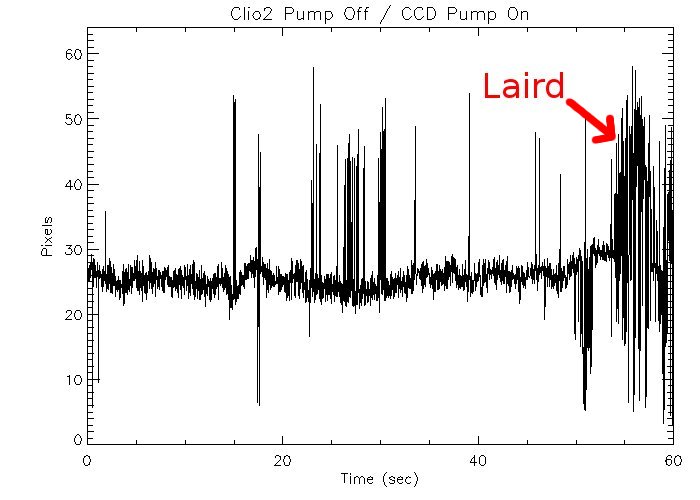
The MagAO project is adding a little bit to the vibrations of the telescope, mainly with two cooling pumps. One pump circulates glycol for our CCDs and the Shutter, and the other keeps Clio2 cold. With the 16x CRO amplification, we really see the impact of these pumps. We recorded 60 sec time series of the CCD47 operating at 32Hz in a 64×64 subarray mode. Here are the results:
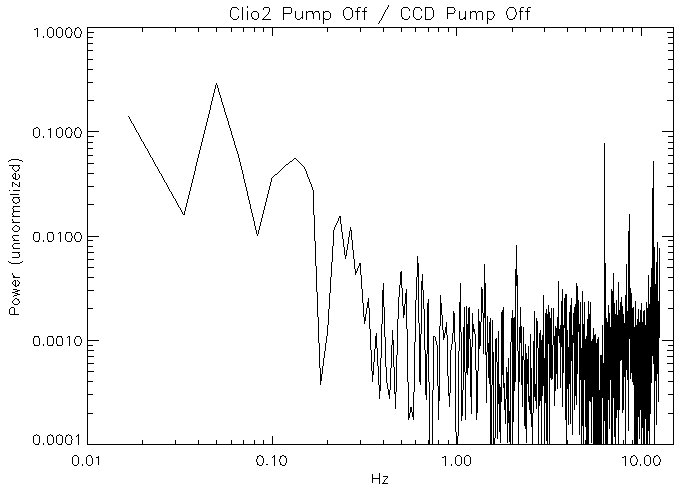
With both pumps off:
Unnormalized power spectrum of the x position of the VisAO image position. Note that I'm being lazy and not fully normalizing the PSD. With both pumps off, we had an rms jitter of 2.2 pixels.
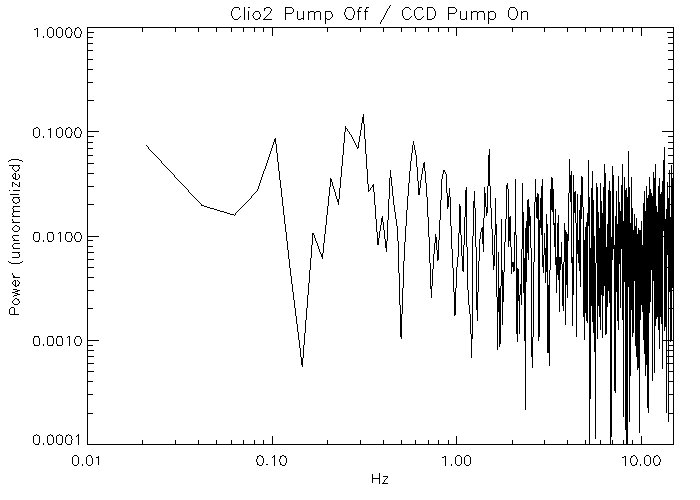
With the Clio2 pump off, and the CCD pump on:
Here we see more white noise, but no strong resonances and the image is fairly stable by eye. Rms jitter was 5.4 pixels.
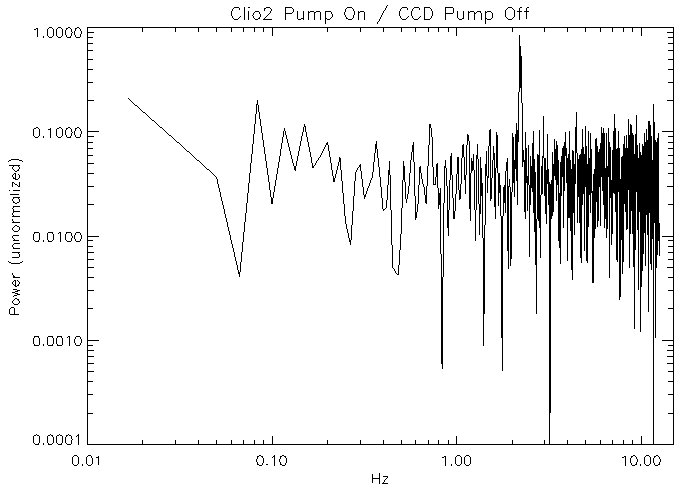
With the Clio2 pump on, and the CCD pump off:
The Clio2 pump excites a ~2.3 Hz resonance. We think this is due to the rack holding the pump sitting on a beam connected directly to the telescope. Rms jitter in this configuration was 9.5 pixels
We are actually very happy with the vibration performance of the system attached to Clay. Taking into account the factor of 16 for the CRO reflection, we expect to have only a few milli-arcsec of jitter when we observe actual stars. We have also taken measurements with our internal artificial star without the CRO and confirmed this. Good news, especially for VisAO.
Another experiment we conducted was having the PI bounce around the control room. He has a noticeable effect.
Time series of the VisAO centroid x position, with some input from the PI.