Laird, Jared, and Katie (new postdoc) arrived yesterday for prep work and then for the Pre-Ship Review that will happen on the 23rd-24th Feb. Katie is getting up to speed on MagAO while Laird and Jared verify that the system still performs as it did last Nov/Dec. It’s chilly in Florence and we are running tests such as starting up the system, homing the motors, etc. We are also setting up the Chem. Lab. as the “Control Room” via ethernet link (and radio for voice) in order to be able to demonstrate remote ops. during the review. We warmed up the bench and got the system up and running, and will close the loop tomorrow.
Blog
Back In Florence
The MagAO team (or at least part of it) has returned to Florence for another round of integration and testing. I (Jared) have been here for 2 weeks, and Laird and Derek just arrived. As soon as I arrived we successfully closed the loop again, with only minimal adjustments of the alignment using the X-Y-Z stages. The system came right back up, with less than 5 minutes of work, after 3 months of down time.
The last two weeks have been mostly uneventful, consisting of a lot of software development and debugging. In preparation for the next 2 weeks of work on the ASM and the CRO tests we removed the NAS from the tower on Friday. The two videos below show the process of lowering, and then tilting the NAS upright on its handling cart.
While the NAS is off the tower we will be fine tuning the WFS and VisAO camera alignment, as well as testing the AO to Magellan software interface. In about two weeks we’ll reverse the process, and mount everything back in the tower for some more exciting closed loop action.
Filter Update
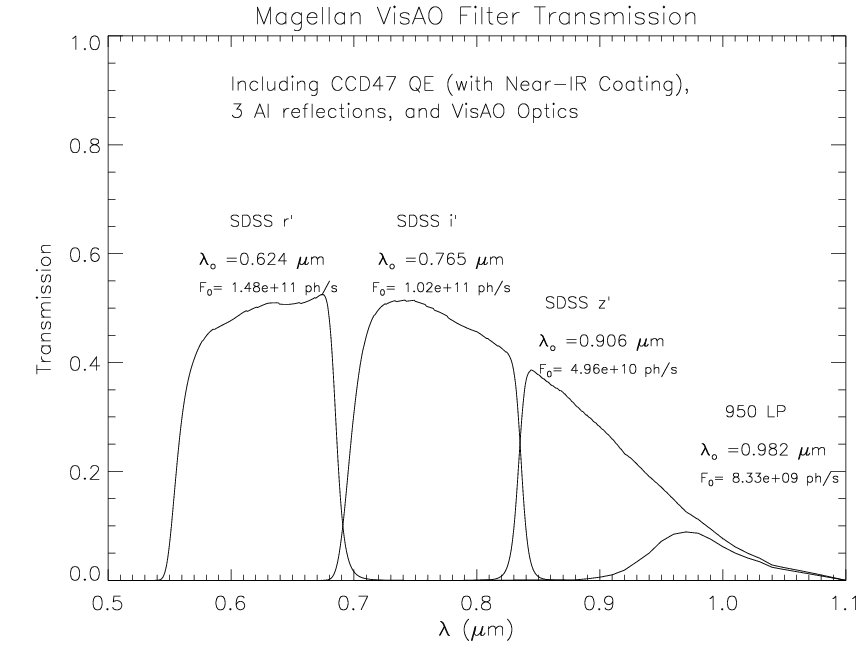
I have updated our VisAO filter curves to now include the effects of 3 reflections from Aluminum mirrors (important because Al has a feature at 0.8 microns), the Clio dichroic, the AR coated surfaces of the VisAO Optics, and the protected silver gimbal mirror in the VisAO camera. Most of these are small losses, but 3 Al reflections are fairly costly at only ~90% reflectance each. I have also convolved the resultant curves with the HST/STIS Vega spectrum to give the approximate photon flux in each filter from a 0 magnitude star. The only major thing not included in these calculations is the reflectance of the beam splitter, since it will vary depending on AO system setup.
MagAO goes to ABOR
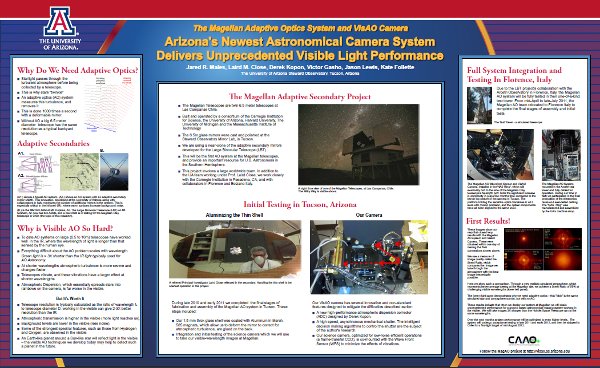
Last week Laird and I had the pleasure of attending the Arizona Board of Regents meeting in Phoenix, and presenting a poster about the Magellan AO system and the VisAO camera. The session we were invited to was on the impact of scientific research on student’s education at Arizona’s universities. Click the image below to download the poster as a pdf. It contains an introduction to AO in general and visible AO in particular, as well as an overview of the MagAO project. We also took the opportunity to show off some of our exciting results from the test tower in Florence.
Movie of the Loop closing
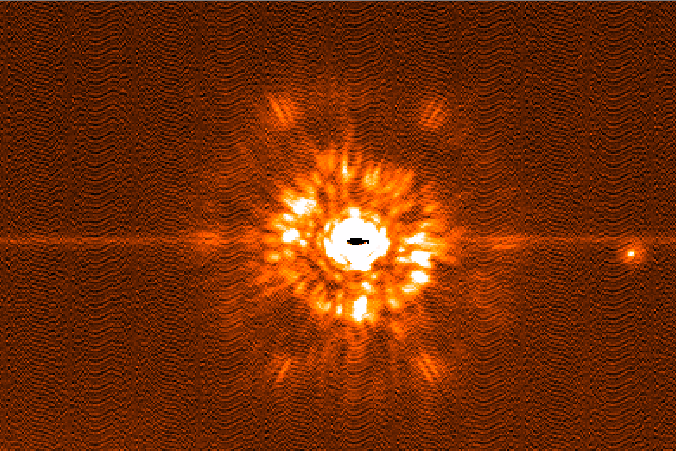
Here is a short film of the VisAO camera at i’ (765 nm) in 0.8″ seeing (33mph wind) with the loop open (0.3% SR, FWHM~0.6″) and closed (55% Strehl, FWHM=0.027″) at 800 Hz (400 modes) in the test tower.
This is a >180 increase in peak counts (and >20x gain resolution) obtained by turning on the loop!
Note that the PSF is saturated out to the first Airy ring in this (rather poor) stretch. The red dot is the focus light from the videocamera (ignore it).