So the last two or three nights we’ve been using MagAO at its geometric limits. By that I mean the various angles and rotations and cable contortions that the exciting science targets required. There was a conversation like this last night (accuracy not 100%):
Francois: “What’s the elevation limit?”
Jared: “Thirty degrees.”
Francois: “So I can go to thirty point zero zero zero zero zero zero one?”
Katie: “It’s not really a goal.”
Tonight Jordan flipped our system upside down about 25 times. It’s designed to do this, of course, but it makes for lots of fun keeping all of the precise alignment from primary mirror to secondary mirror, and down the PyWFS optics. Kate did a fantastic job keeping up with all of the camera lens re-alignments and axis changes on the pyramid. Still though, after a couple of nights of defending MagAO from marauding observers I feel a little like Captain Jack:
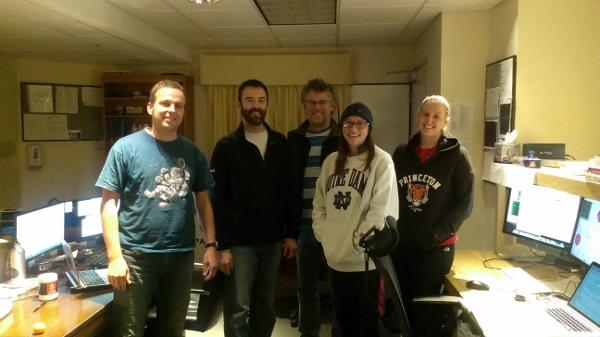
We forgot to post this last night. Here’s Francois Menard and Jos de Boer with the MagAO team.
Jos, Jared, Francois, Katie, and Kate.
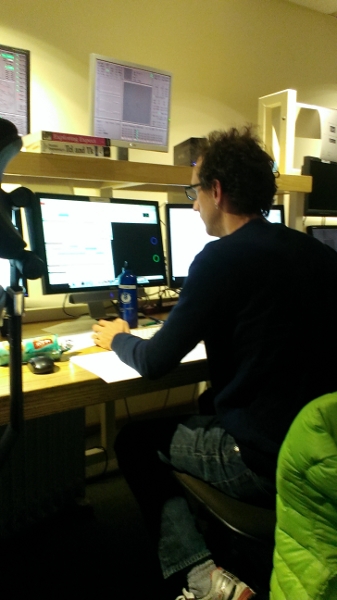
And Jordan hard at work with Clio.
Here’s Jordan formulating his next malicious attempt to destroy MagAO
And our usual assortment of day-in-the-life pretty pictures.
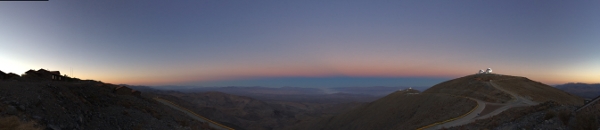
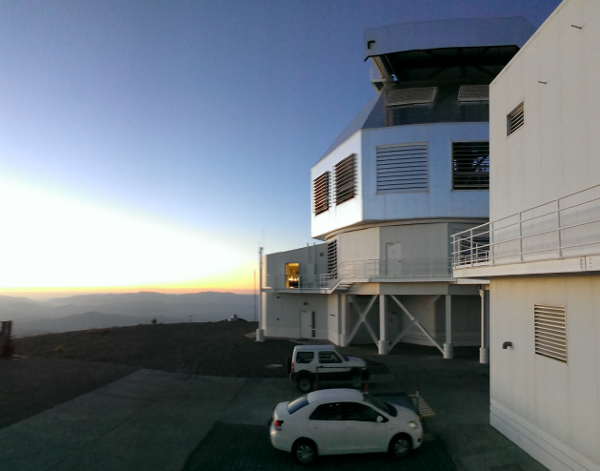
Povilas and Francesco gave the DIMM (the seeing monitor) a little T.L.C. at sunset. (P is waving)Kate took this panorama on her walk tonight.This is just after last night’s epic green flash. It think it’s because it was behind the peak, so it was well above the marine haze.
I had some good metal picked out for tonight, but I think we need to just relax a little. Here you go.
We had an action packed night, with many more targets than we’ve been observing so far on this run. The AO system wasn’t on its best behaviour, but we have learned to recognize most of its bad moods quickly and we can usually slap it back into shape right away.
A door opens to a busy night
Kate Follette is here, ready to help take up some of the operations load. Our visiting observers tonight were Hector Canovas and Adam Hardy from Universidad de Valparaiso. Here’s a shot of the bleary eyed “aoistas” this morning right before we quit, minus Katie who’s behind the camera, and minus Kate who went to bed too early to get her picture took.
Left to right (in 2D): Jared, Adam, Hector, and Jorge. Katie is behind you. Kate == false.
In Kate’s defense, she made it to the half-way point after 24 hours of travel from Tucson.
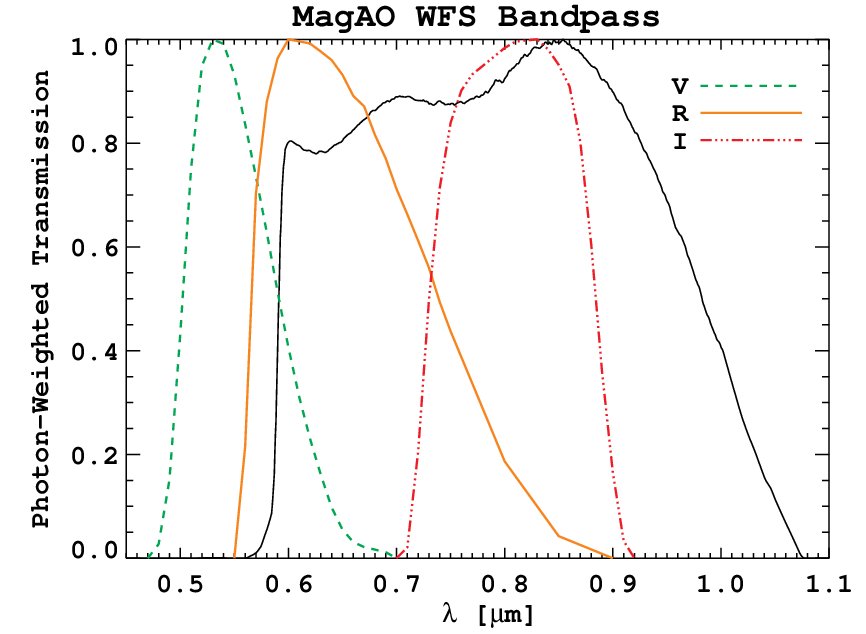
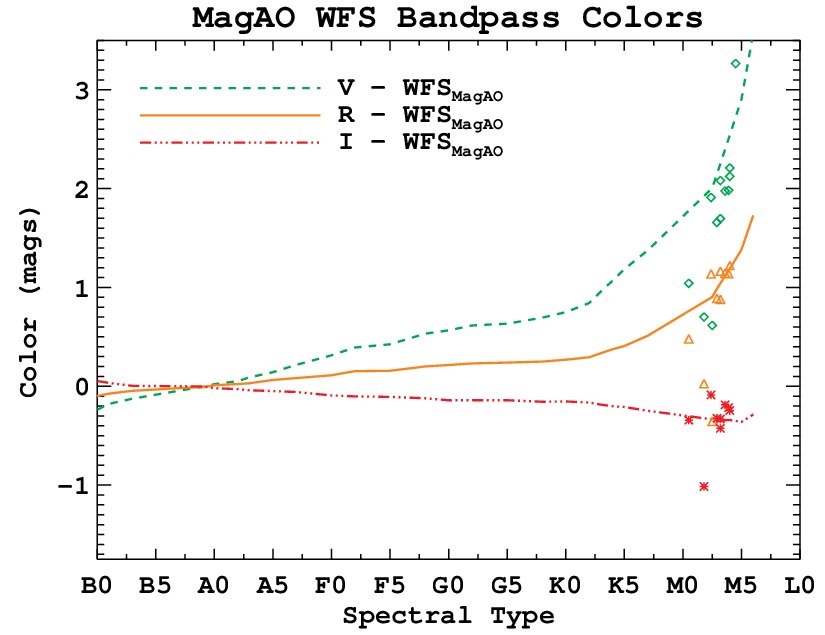
Most of the targets we looked at for our new friends Hector and Adam were faint and red. When we set up the system for such targets we need to have a good guess how many photons per second the pyramid wavefront sensor (PyWFS – following the obviously correct conventions of Guyon 2006) will get. This can be tricky because our PyWFS has a very wide and very red pass band, something like R+I. So if you use the R magnitude on an M5 star, you’ll set up to run slower and with fewer modes than you need too. It’s worse if you give us the V magnitude. So tonight I whipped up a set of synthetic color corrections, and compared them to our PyWFS’s own estimates.
UPDATE: A day later, we have investigated why the R band colors were weird in the first version of these plots. We are now using a self-consistent set of VRI magnitudes, from the USNO UCAC4 catalog, transformed from APASS gri (AB). I think we can now declare the MagAO WFS pass band done. I’ve updated the next two plots to the latest, most correct version.
Our PyWFS filter, calculated from manufacturer curves for everything I can think of. The VRI curves are from Bessel (nineteen I forget the year).MagAO WFS color corrections from standard “Bessel” VRI filters, using the Pickles spectral atlas. The data points are from the PyWFS estimated magnitude which is an independent calculation of Alfio’s, and the UCAC4 magnitudes.
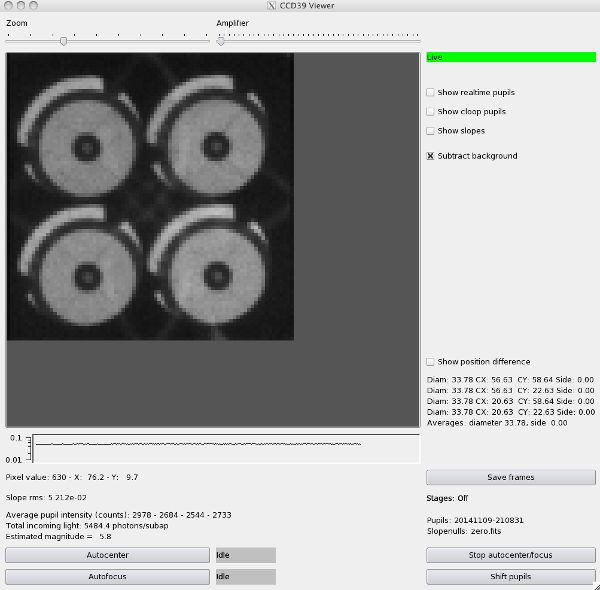
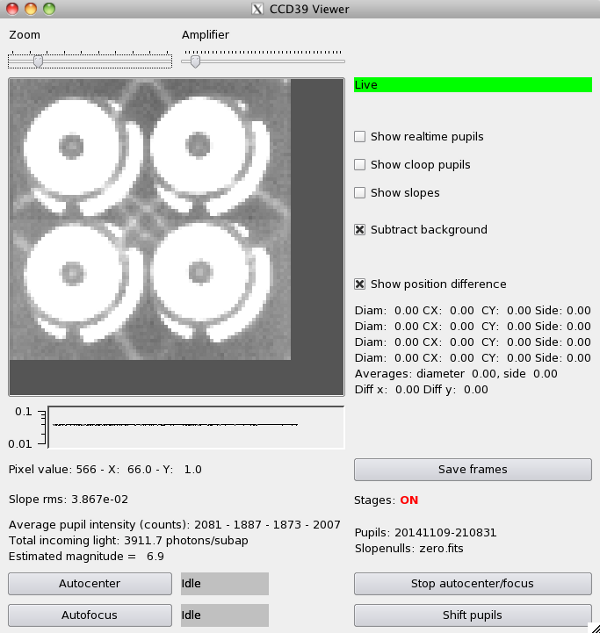
Here’s a fun set of bookends on the night. We took flats at evening and at morning twilight. During this, you can see a really cool pattern on the PyWFS. You can also see the secondary mounting structure lit up by the sun. See the difference?
ThePWFS during night time flatsThe PWFS during morning flats.
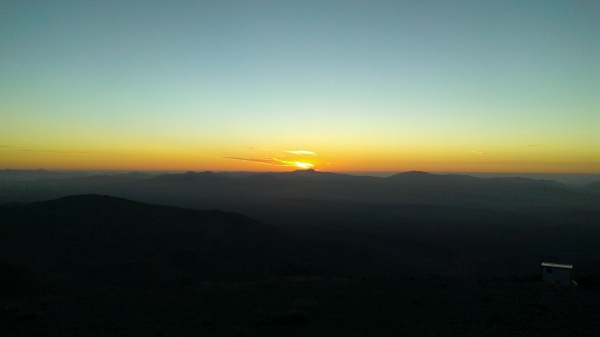
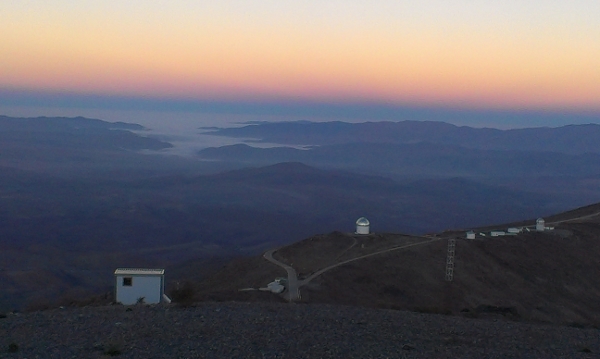
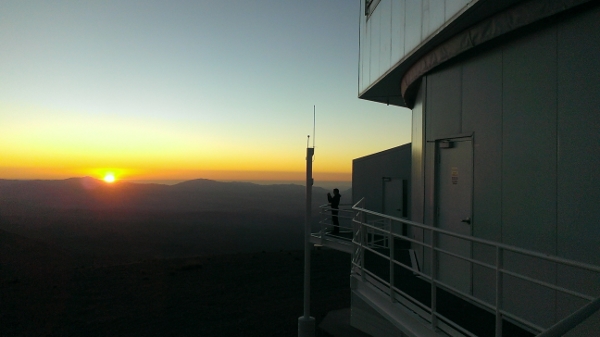
Here’s a just-after-dawn shot to the west, towards the Pacific Ocean.
The marine layer intrudes through the coastal passes below us every morning. It tries, but almost never makes it here.
Though you might think this was about the ASM supports being too reflective, the song of the day is for Veteran’s Day.
Our T.O. for the last week, Jorge, has dubbed us “the aoista operation”. Tonight was pretty calm – no major technical problems, a few scientific discoveries, and a pretty relaxed night. The clouds rolled in a couple of hours before dawn, so we closed out with some minor engineering tasks.
Tonight was TJ’s last night. So long. Kate is (possibly) arriving today, and tonight is the first night for our Chilean observers. We’ll have some new faces on the blog this week.
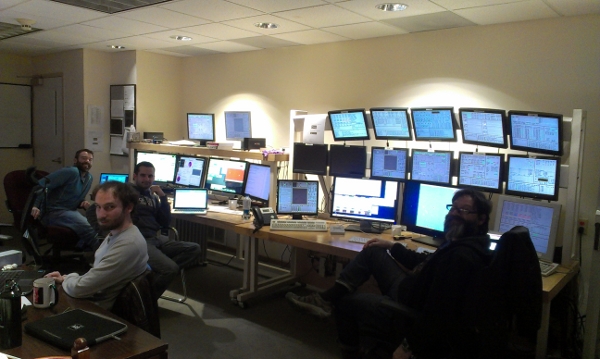
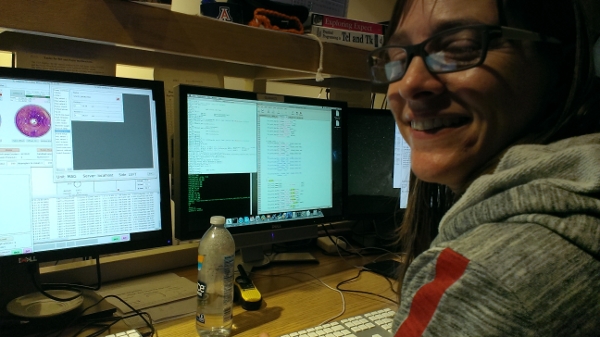
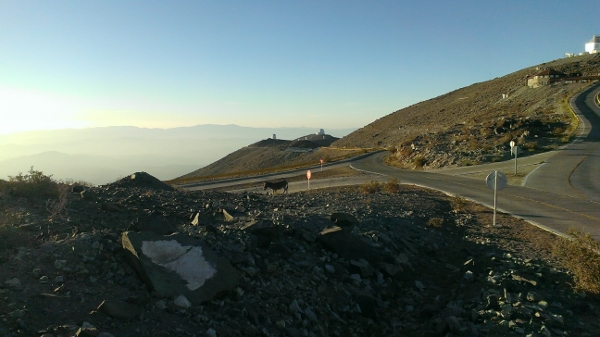
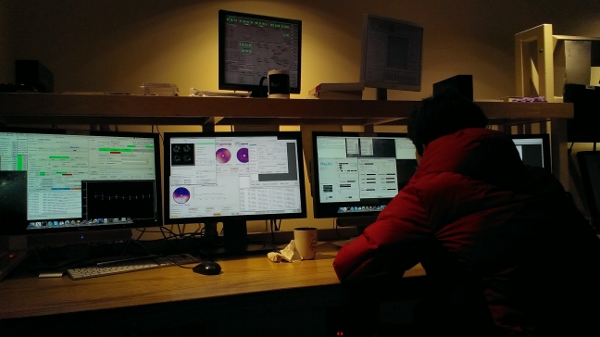
Here’s what the control room looks like from the middle of a calm nightKatie worked on Clio’s FITS headers. If you look closely she’s editing the c code that runs Clio.A lone burro was seen after dinnerNo burrows at the top today. But they were there earlier.
Now that we have 3.3V where we’re supposed to have 3.3V, and we’re using good fiber cables, everything is easy. It was also a nice night, with stable (if not always good) seeing. This is much more relaxing than some earlier nights. It also means there isn’t much to write about.
I pretended to be Yuri tonight.T. J. closed the loop for himself.
These next two pictures were taken about 10 minutes apart.
Well things finally got back to normal tonight at LCO. Not a cloud in the sky, seeing was 0.5 arcseconds most of the night, T.J. fell asleep in the control room, and most importantly – our good friend Miss Viz was hanging out at the clean room today! We haven’t seen any Viscachas on their usual roosts, but one was there today.
Miss Viz, one of the clean room Viscachas was spotted for the first time on this run.
As I said, tonight we got the absolutely perfect observing conditions we’ve come to expect from LCO.
Finally, a cloud-less sunset.The ASM as we opened for what turned out to be an amazing night.
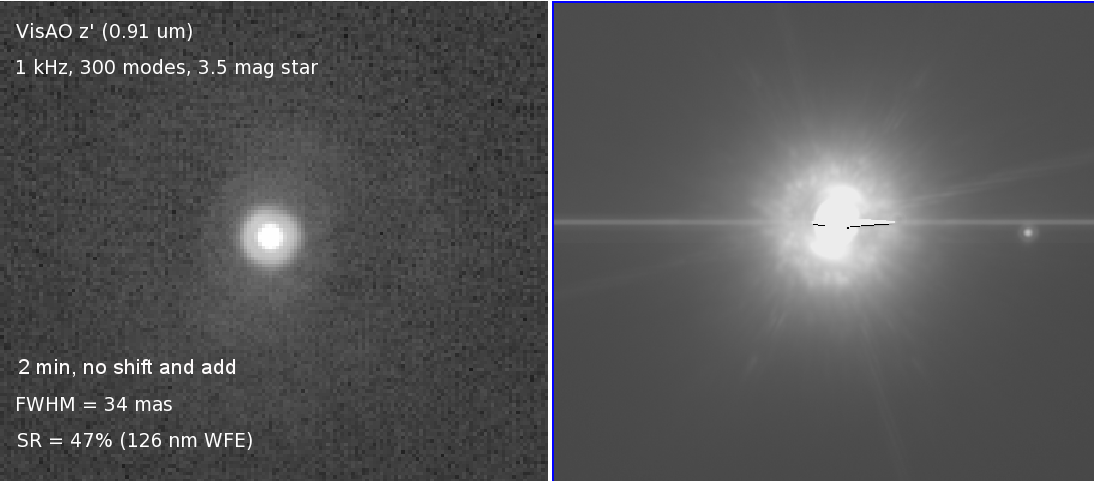
The great conditions have led to some really nice results. Here’s a 47% Strehl ratio image at z’ (that means it’s really good).
We took these images tonight. At left is with an ND filter to prevent saturating. At right is a no-ND deep exposure, where you can see the spider arms and other high-contrast details. The junk in the center is CCD bleeding. Click for more pixels.
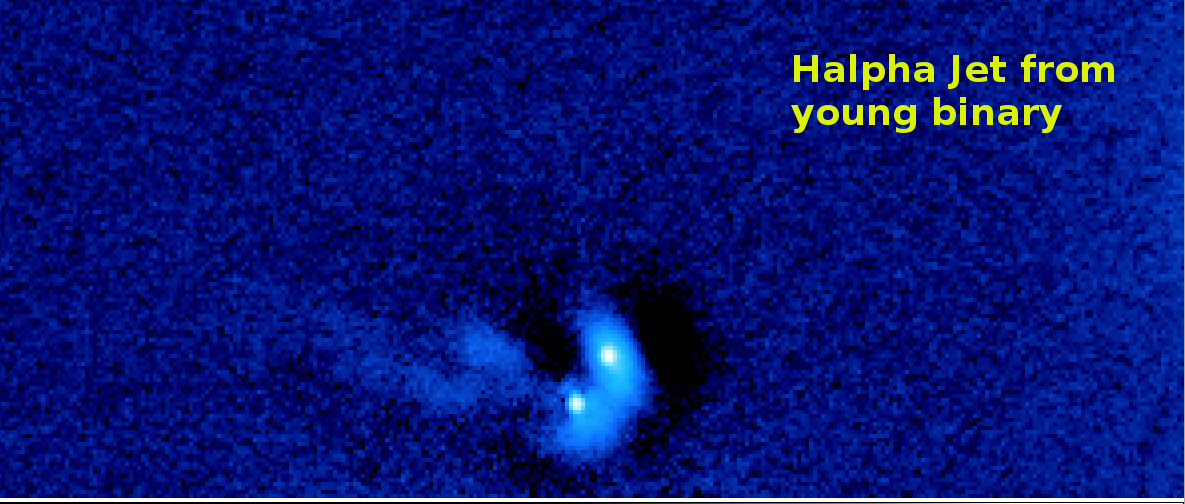
We also did some work at H-alpha. Here’s a nice H-alpha jet coming from a young binary star system. FWHM in this image is 30 milli-arcseconds. That’s from stacking 15 second exposures.
An H-alpha jet imaged with MagAO’s VisAO camera in SDI mode. Click for more pixels.
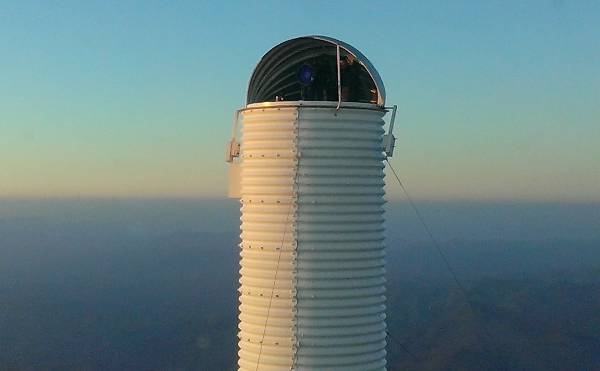
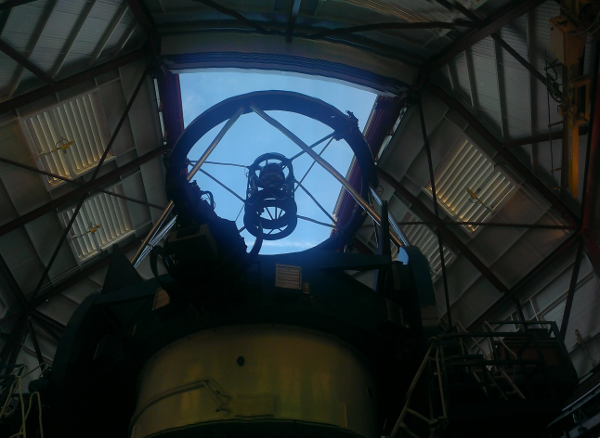
At the end of a great night, we saw a gorgeous sunrise over the Andes. Here’s a shot of the MagAO ASM, Clay, and Baade right before we closed up.
A sunrise shot of the MagAO secondary at the top of Cerro Manqui. Anna, you can click for the high-res version.
I don’t think these have been on the blog yet this run.
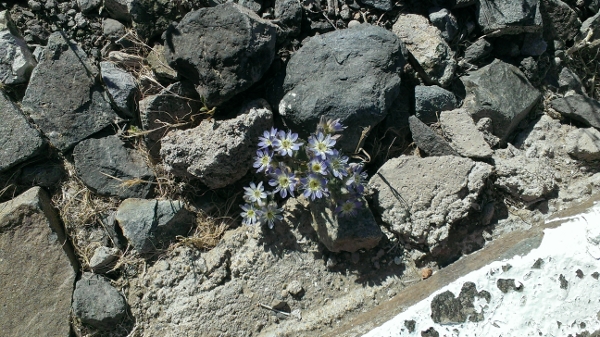
Some more nice flowers,
So, the last week has been pretty rough from an observing perspective. The clouds and bad seeing means a lot of stress and frustration. I think this video captures what it’s like sometimes in the control room during nights like we’ve had up until now.
Here’s the song of the day. I’m guessing this is going to be a staple at McKale center this year.