2014B Day 5: Corrected Dispersion

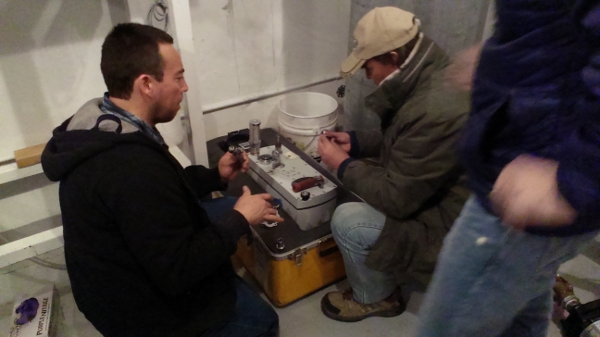
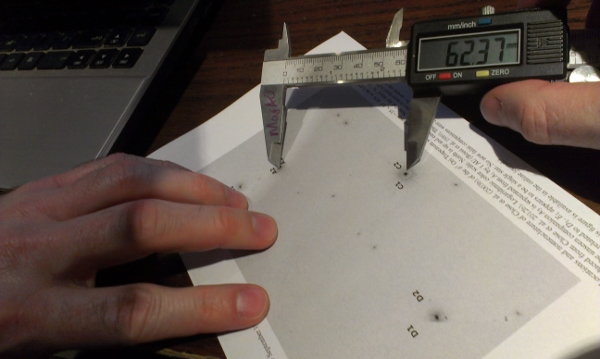
The big story over the last 30 hours has been our atmospheric dispersion corrector, or ADC. When you look at a star through the atmosphere, it will be “dispersed” into a rainbow, meaning that the different wavelengths of light (colors) will land at different spots on the camera. But if you have an ADC, it takes out this dispersion. The ADC is two prisms which have to be rotated in opposite directions in a fairly precise way. Well, ours stopped being precise, or maybe it was just random. Opinions vary. We spent the last half of last night taking pieces of it apart and testing various theories. We didn’t get anywhere, but after a long-day’s sleep, Laird had a plan. To keep a long story from getting longer, one of the two rotating prisms tends to get jammed up in one part of its range of motion. We now have a workaround in place for this, with a bunch of software hacks to enforce some new rules. So, problem solved! Just like that.

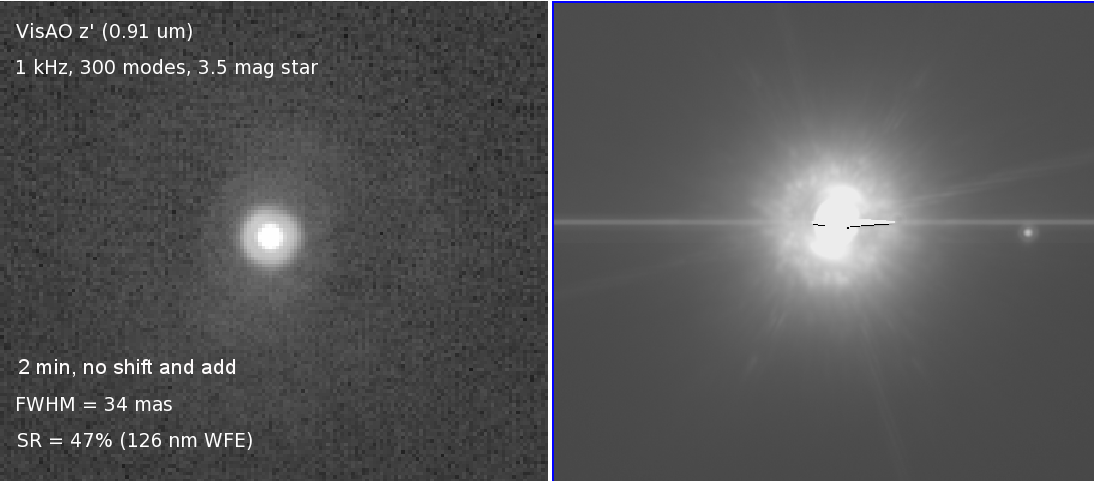
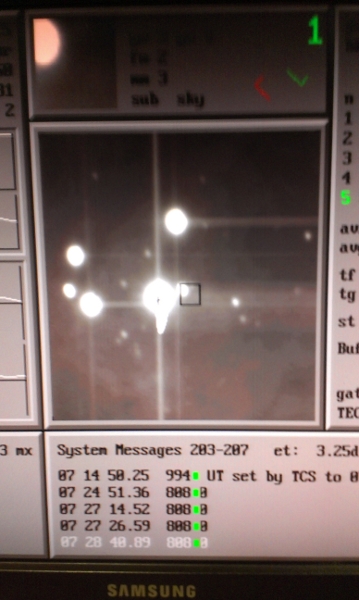
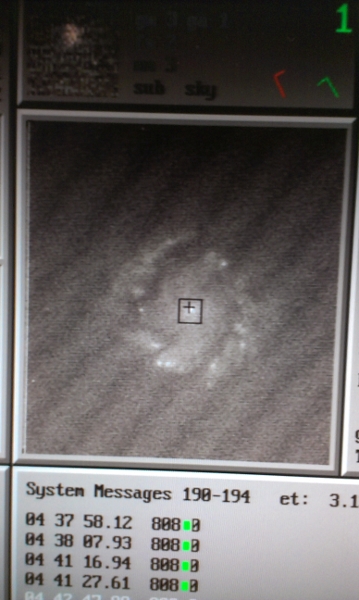
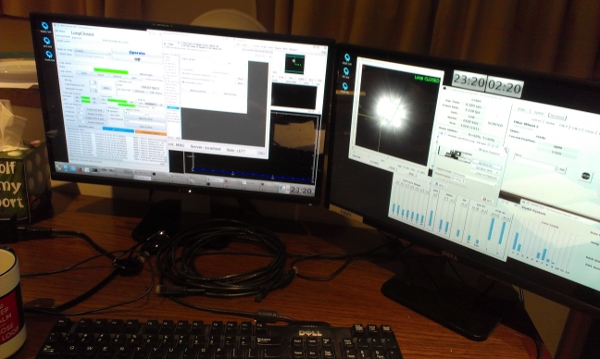
That image makes me pretty happy. See how the lines (they’re speckles in a very broad pass band) running out from the star are all straight? That means we have the ADC working.

To put that in perspective, when I went to bed yesterday morning I was pretty sure we had to pull MagAO off the telescope and tear apart the ADC. It’s good to be wrong about some things.

Losing some time to the ADC troubleshooting hasn’t been too hard to take, because we’ve had some cloudy nights.

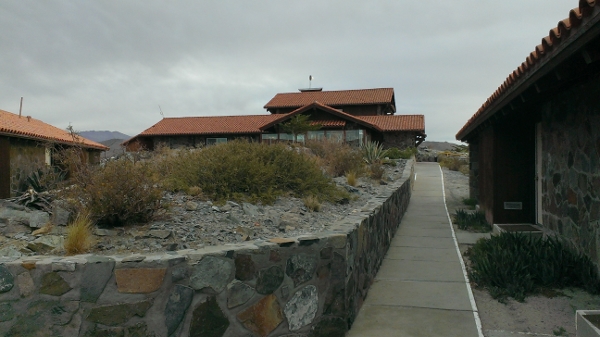
The Babcock Lodge with some clouds
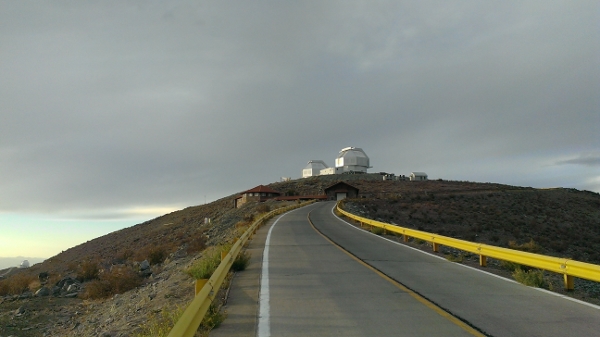
Magellan with clouds. This is a rare sight as far as the MagAO team is concerned.

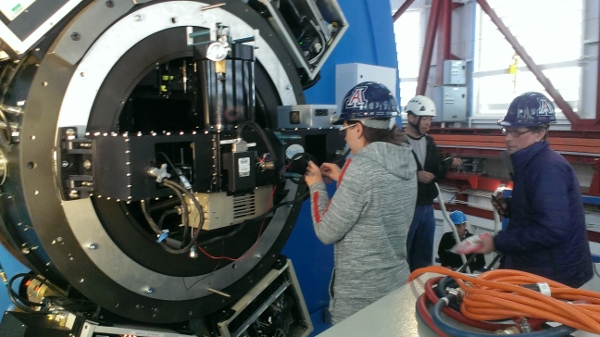
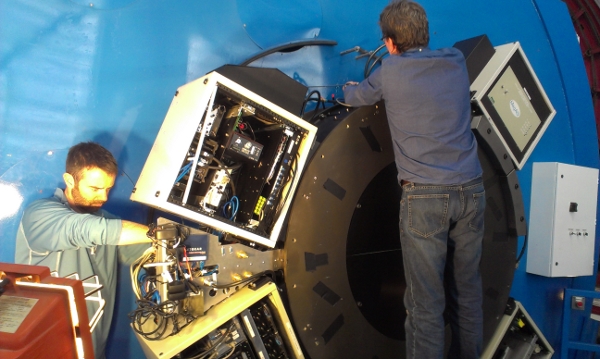
Here are some more pictures of the mounting and cabling from yesterday.

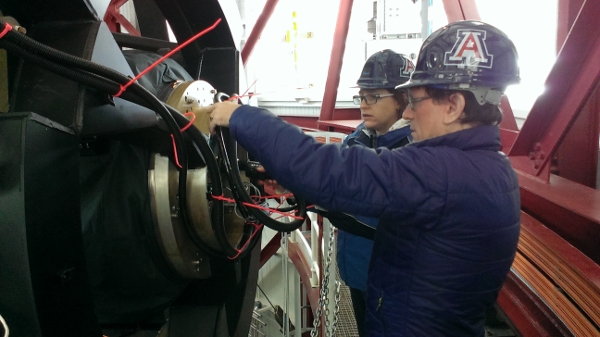
Laird and Katie hooking up Clio
Here’s Laird and me connecting all the cables that let us talk to the system.

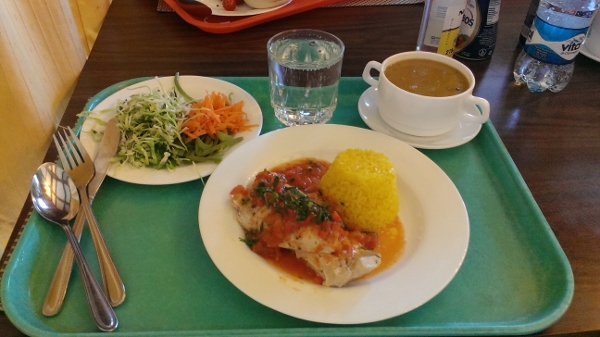
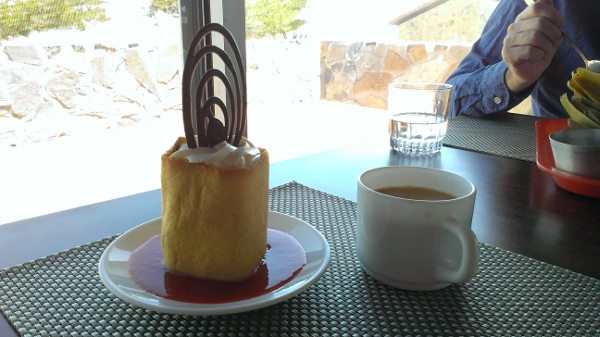
MagAO’s favorite Chef is on this week. Here’s an example of why we love Hector so much.

This was dessert at Lunch! You should stop by for dinner some time.

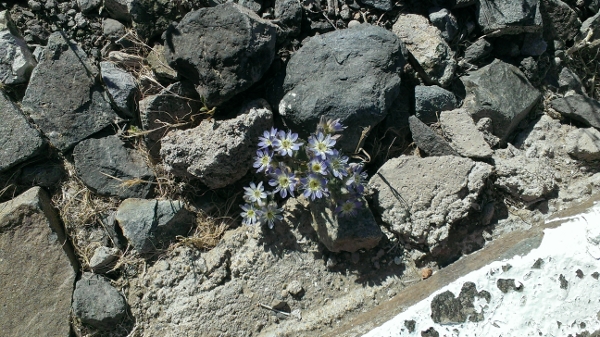
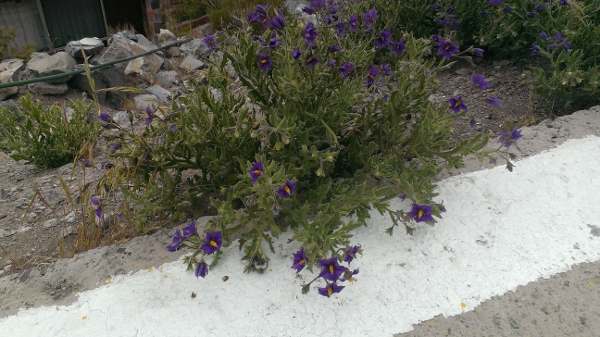
I found some more flowers today.

Some more flowers.

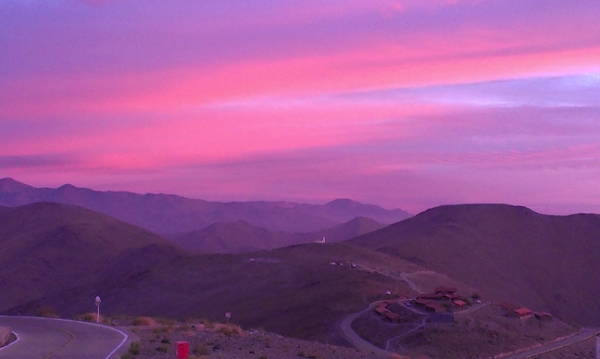
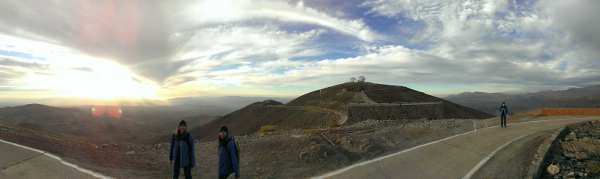
Clouds suck. They should never come near any observatory where I have time. But, they make for nice pictures.

Tonight’s sunset. Click for panorawesome.
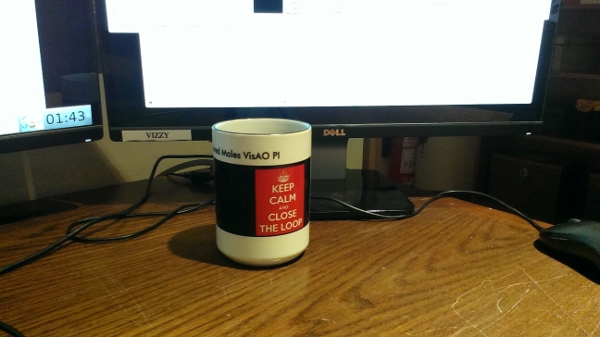
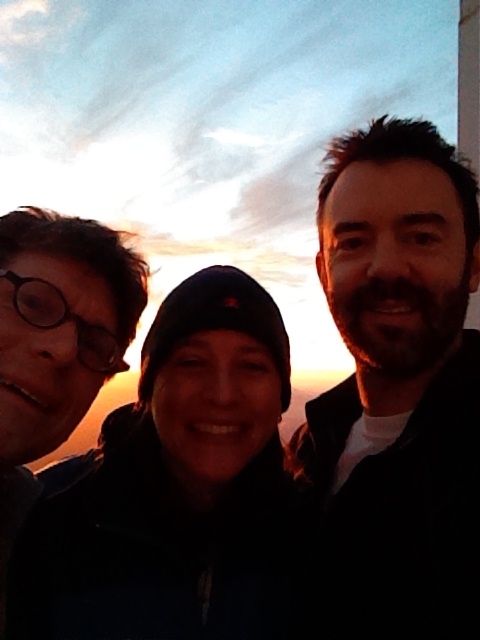
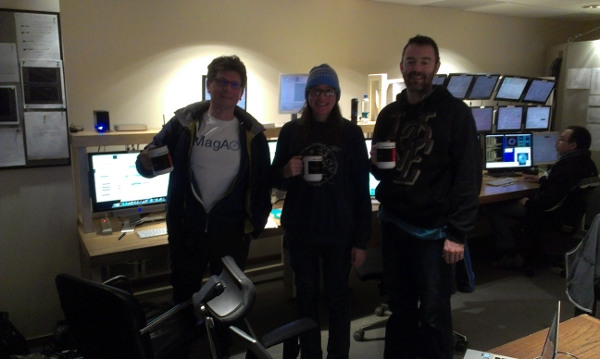
The MagAO team shows off some of our swag. Note that I’m not looking at the camera, I got distracted by the loop “pausing” and was making sure it came back ok.

There’s a lot of pressure for us instrumenteers in the days before a run, especially such a long one. We have many people coming to visit us and use MagAO, and we need to have the system in top form when they get here. I think we did it — MagAO is ready to go. But, needless to say, we worked pretty damn hard the last couple of days.

2014B Day 3: Switched On and Switching Over

The big news for today is that Laird and Katie cabled, plumbed, and powered-up the ASM. We’ve never done that before without at least one Arcetrian in the room. It all went very smoothly, and the ASM is ready to go on sky!

Laird and Katie connected the ASM power and communication cables and the cooling lines.
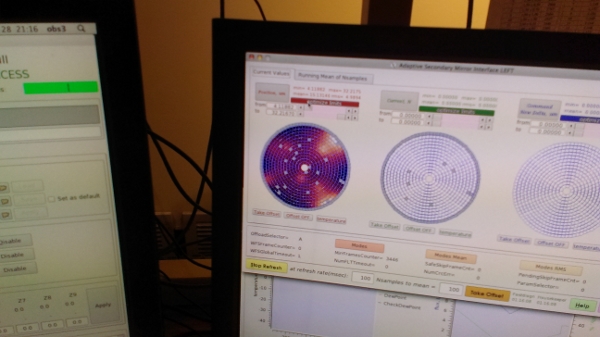
This nice display shows our shell in the “RIP” (rest in peace) state. We were happy to see this, as it meant all the electronics were working.

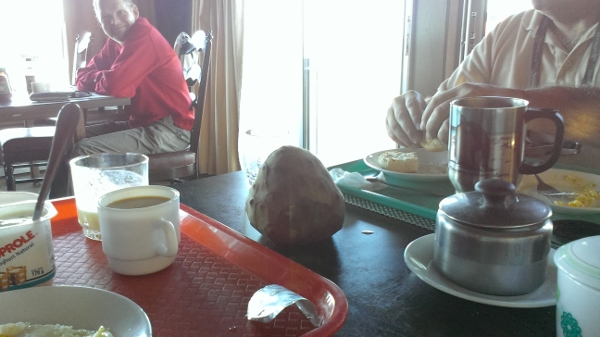
Our day started with Oscar introducing us to the Cherimoya. It’s a really flavorable sweet fruit. We also had fresh squeezed Cherimoya juice for breakfast.

That”s a Cherimoya. In front, that is. That’s Povilas in back.
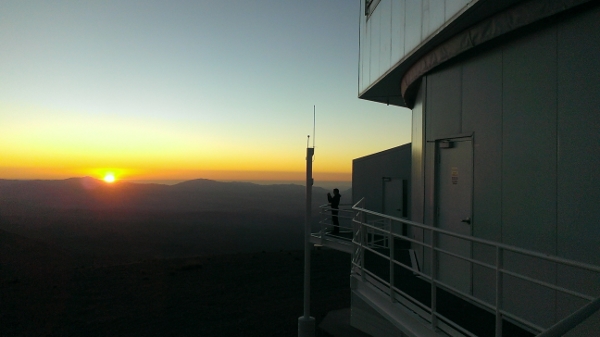
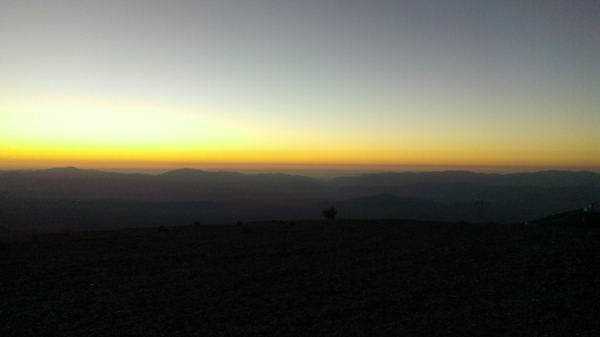
Tonight’s sunset, or just after it.

We started switching over to a night schedule. That means we got up for breakfast at 7:30 and worked until 2 am. We finished out the night testing some new plumbing fixtures for the NAS. At least we’ll sleep in a little this morning.

We should be on-sky tonight. Baby get ready.

2014B: Hard Work

MagAO has produced another Ph.D.! Kate successfully defended her dissertation on Thursday, at the very un-Astronomer hour of 9 am. Nevertheless her talk was well attended, and all of that hard work paid off. Congratulations to Dr. Kate Follette, Queen of VisAO SDI.

Kate describing the recent successes at imaging transition disks. Free sticker to the first person who names all the MagAO team members in this picture.
Laird delivering the advisor’s toast to Dr. Follette.

Now that the fun is over, Laird,Katie, and Jared are heading down to LCO for MagAO’s 2014B science run. Our flight leaves Tucson this afternoon. We get the telescope for 37 nights, and we’ll be down there for 6 weeks. That means you get over 40 blog posts in a row. Lucky!

I’m feeling the need for some motivation. It’s time for us to pull our (steel-toe) boots on, lace ’em up, and earn our pay. Here’s what we’ll be singing as we march up to the telescope every day for the next 6 weeks.

Sagan 2014: Imaging Planets and Disks

This past week the NASA Exoplanet Science Institute (NExSCI) hosted the 2014 Sagan Summer Workshop, which was on Imaging Planets and Disks. Several members of the MagAO team and extended family attended, and presented some of our latest and greatest results. The workshop was held on the campus of Caltech, in Pasadena.

We all learned a lot, and had some fun. Thanks to the whole NExSCI crew for putting on such a great workshop.

Kate wowed the crowd with her H-alpha images
Here’s Ya-lin, presenting his VisAO results on CT Cha b.
Arizona grad student Nick Ballering giving his poster “pop”
Arizona grad student Steph Sallum showed some MagAO+Clio2 non-redundant masking results. Her slides were very patriotic.

The real star of the show was Space Shuttle Endeavour, which has retired to the California Science Center. We took Wednesday afternoon off to go see her, and it was amazing.

Space Shuttle Endeavour. A good ship.

At one point while preparing for my thesis defense, I was faced with a conundrum: work on my dissertation or do something else. So what I did was research my academic lineage. It goes something like:

Jared Males –> Laird Close –> Don McCarthy –> Frank Lowe –> (a bunch of nerds at MIT) –> Robert Millikan –> Albert Michelson.

No disrespect to everybody else, but those last two dudes are pretty big deals. Well, since I was at Caltech, I went and paid Dr. Millikan a visit.

Me and my academic great^N grandfather. He has a nobel prize, by the way. So does his advisor.

I also visited the other famous residents of the campus.

The famous turtles of Caltech

SCExAO: The World’s Highest Altitude Pyramid WFS

I’m on Mauna Kea visiting Olivier Guyon and the Subaru Coronagraphic Extreme AO (SCExAO) system. At 13,800 feet I’m pretty sure this is the highest altitude pyramid AO system in the world. Despite having a pyramid wavefront sensor, SCExAO is a pretty different AO system from MagAO. For one thing, there isn’t an adaptive secondary. Instead, the deformable mirror is on an optical bench off to the side. SCExAO is also not the only AO system – before light gets to SCExAO it has been corrected by the AO188 system, which is the AO workhorse of the Subaru telescope.

The SCExAO+VAMPIRES+FIRST teams hard at work.

SCExAO hosts several science cameras, including VAMPIRES and FIRST which are being engineered on this run. I’ve also seen some impressive demonstrations of low-order wavefront sensing, focal plane wavefront sensing, and speckle nulling. SCExAO has some really exciting high contrast imaging capabilities.

The SCExAO pyramid pupils and the H band PSF.

As you can see, the SCExAO team is very creative with their camera displays. They consider Chuck Norris to be their spiritual leader, though somebody seems to like My Little Ponies.

Nem operates the Brony cam.

Mauna Kea is high, and the air is thin up here.

The two Keck telescopes and Subaru. Click for more cowbell.

We stay at Hale Pohaku (HP), which is at a more comfortable 9000 feet.

The dorms at HP. Not as cozy as LCO, but very nice.

One thing that I learned during this visit is that if Olivier ever asks you to go for a walk, you say NO. What he considers a “walk”, most people would consider “rock climbing in the dark”.

Mauna Loa through the clouds. I thought maybe this was when we’d turn back. I was wrong.

The view is amazing from up here.

The sunset from Subaru’s observation porch.
The view to the northwest just after sunset. Click for more cowbell.

Being back in Hawaii reminds me of old times. The song of the day describes one of life’s enduring mysteries, which I still have little insight into.